


You're probably staring at a dashboard, a CRM, and a half-finished AI proof of concept, trying to work out why the model looks promising in the notebook but still isn't useful in the real workflow. That gap is where AI integration services earn their keep. They turn model outputs into something your people, systems, and controls can use inside UK production environments, under UK GDPR, sector rules, and the messy reality of legacy platforms.
What AI Integration Services Actually Cover
AI integration services are the engineering work that connects AI models, data pipelines, and orchestration layers into existing business systems such as CRM, ERP, contact centre, and data warehouse environments. The difference from model development is simple, the model answers the question, but the integration work makes sure the answer lands in the right process, at the right time, with the right permissions.
From business problem to live workflow
Most UK buyers don't start by asking for “AI”. They start with a pain point, such as slow case handling, manual document triage, poor search across internal knowledge, or forecast updates that arrive too late for planning meetings. The buyer journey usually runs through discovery, vendor selection, a controlled pilot, production rollout, and ongoing monitoring, and each stage exposes a different kind of integration risk.
That's why the scope of a proper engagement usually includes discovery, data readiness, model selection, API and middleware integration, change management, and governance. A team might buy a hosted model, fine-tune one, or reuse an existing platform, but the hard work is still wiring outputs into operational screens, queues, and approvals. If you need a broader systems view before procurement, LAD's software integration services page is relevant because AI only becomes useful when it fits the wider application estate.
Practical rule: If the AI output doesn't land inside a system people already use, adoption falls back to copy-paste work and the pilot stalls.
What it does not cover
AI integration services do not replace product strategy, data ownership, or the business decision about whether the use case is worth automating in the first place. They also do not remove the need for process redesign, access reviews, or policy decisions about what the AI is allowed to do on its own. That distinction matters during procurement, because scope creep usually starts when stakeholders assume the vendor will also solve data quality, operating model design, and governance sign-off in one package.
A clean brief separates the model layer from the systems layer. That keeps vendors honest, gives security teams something concrete to assess, and stops the project turning into an open-ended transformation exercise.
Common Use Cases and Service Categories
The five service categories UK teams buy most often are model integration, LLM and generative AI integration, chatbots and agents, process automation, and data and MLOps services. They overlap in practice, which is why production deployments usually need three or four working together instead of a single “AI project”.
The five categories buyers actually ask for
| Service Category | Typical Buyer Question | Representative Example |
|---|---|---|
| Model integration | How do we place a prediction inside an existing system people already trust? | A forecasting model writing demand updates into an ERP planning screen |
| LLM and generative AI integration | How do we ground answers in our own documents instead of getting generic outputs? | A hosted LLM connected to a policy knowledge base for document Q&A |
| Chatbots and agents | How do we deflect routine queries without losing customer context? | A service assistant pulling case history from CRM before suggesting a reply |
| Process automation | How do we remove manual triage from a repeatable workflow? | AI-assisted document classification feeding downstream RPA |
| Data and MLOps services | How do we keep the system accurate after launch? | Feature stores, retraining pipelines, and evaluation harnesses |
Where the buyer questions usually point
Model integration solves the question of where the prediction lives. If planners still have to log into another tool to see demand, the model exists, but the business benefit leaks away. LLM integration answers the harder question of how the model stays grounded, which is why retrieval and document indexing matter more than prompt cleverness.
Chatbots and agents solve context switching. A customer service team does not need a chat interface that forgets every prior interaction, it needs one that pulls case history, product data, and booking detail before drafting a response. Process automation focuses on removing repetitive human handling, while MLOps keeps the machinery alive after go-live.
For teams mapping API-heavy delivery patterns, the AgentStack API integration guide is a useful technical reference because these projects often succeed or fail at the orchestration layer, not the model layer.
The recurring mistake is to buy these as separate initiatives. In production, they behave like one stack, with one data flow, one security model, and one set of operational failure points.
Representative combinations that work
A finance team often pairs document extraction with workflow automation and observability. A customer service operation often pairs a grounded LLM, CRM integration, and human escalation rules. A planning team often pairs forecasting, ERP integration, and ongoing evaluation. That combination thinking matters because the business user experiences one process, not five isolated tools.
Architecture and Data Requirements
A workable AI integration architecture has five layers, and each one connects to existing systems rather than replacing them. The stack starts with data sources and ends with business consumption, but the value comes from the links between layers, not from any single component.
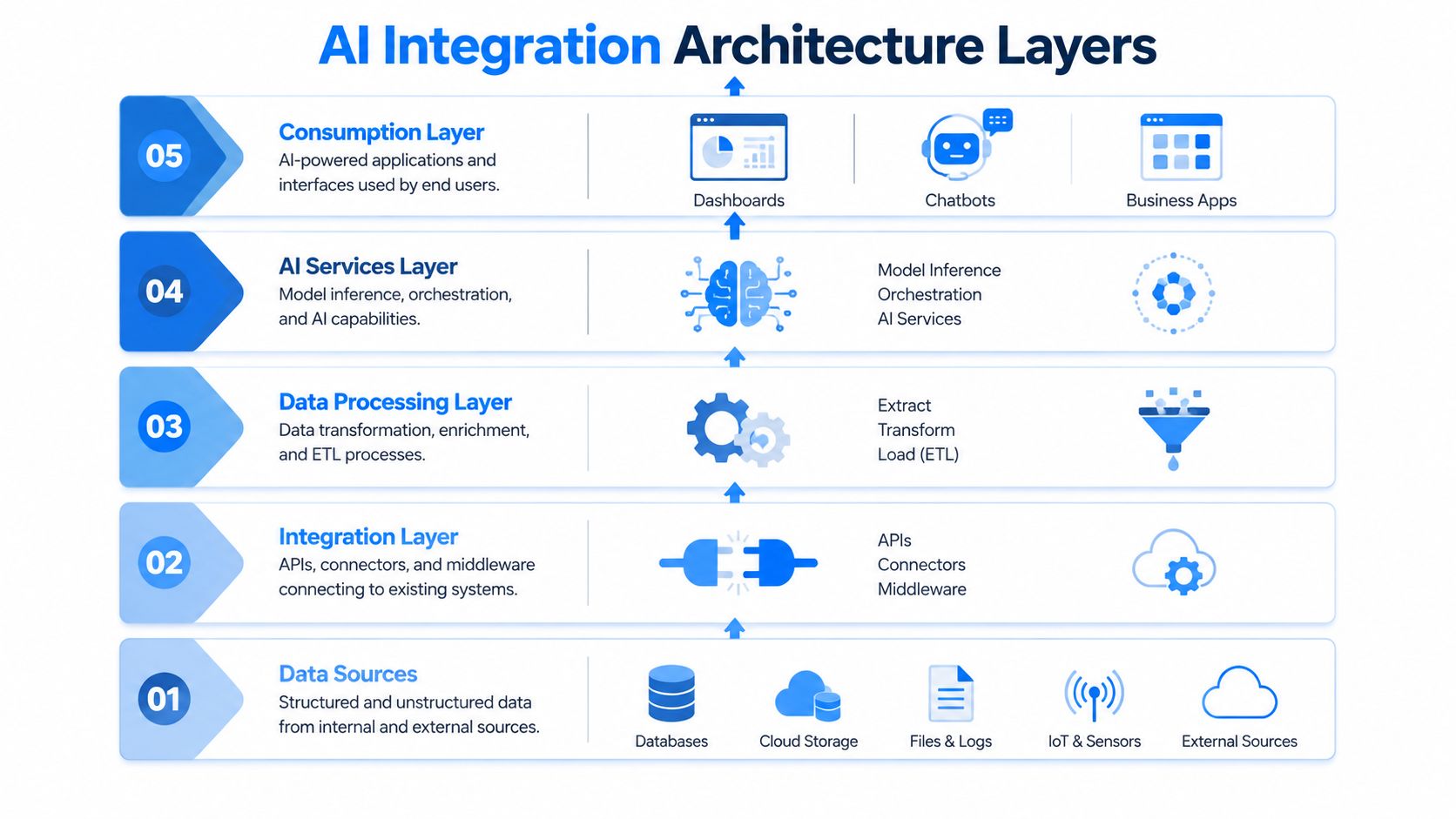
The five layers that matter
The data layer includes sources, lakes, warehouses, and feature stores. Quality and lineage are critical here, because the model output is only as trustworthy as the data it receives. The model layer may be hosted, self-managed, or fine-tuned, depending on the use case and the control requirements.
The orchestration layer handles queues, prompt routing, retrieval pipelines, and agent frameworks. This is the layer that connects the model to context, business rules, and fallback logic. The application layer sits inside CRM, ERP, contact centre tools, custom apps, and APIs, where users see the result.
The observability layer tracks logs, evaluations, drift, and cost. Without it, production AI becomes guesswork after launch. If you're wiring this into an existing estate, secure API gateways, event buses, identity providers, and iPaaS tools do the bridge work, especially where legacy platforms weren't designed for AI traffic.
Data requirements for a real pilot
A pilot needs a minimum viable dataset, not a perfect one. The data must be representative of the live workflow, labelled where supervision matters, and protected by access controls that match the sensitivity of the source systems. Data lineage and labelling strategy matter because the team needs to know what the model saw, what it produced, and which source records were involved when something goes wrong.
Practical rule: Start with the smallest dataset that still matches the production workflow, then add edge cases after the first evaluation run.
The first architectural decision
The first decision UK teams face is where the AI workload runs. That choice drives data residency, latency, integration patterns, and the level of control needed around logging and access. A regional hosted service reduces platform work, while a self-managed or private deployment usually increases governance overhead but gives more control over data flow. The right answer depends on the sensitivity of the workflow and the systems it has to fit into.
Tooling, Infrastructure and the Development Workflow
The practical toolchain is boring in the best way. It needs to get a notebook experiment into a production feature without breaking security, latency, or finance controls, and the tooling should follow that workflow, not the other way round.
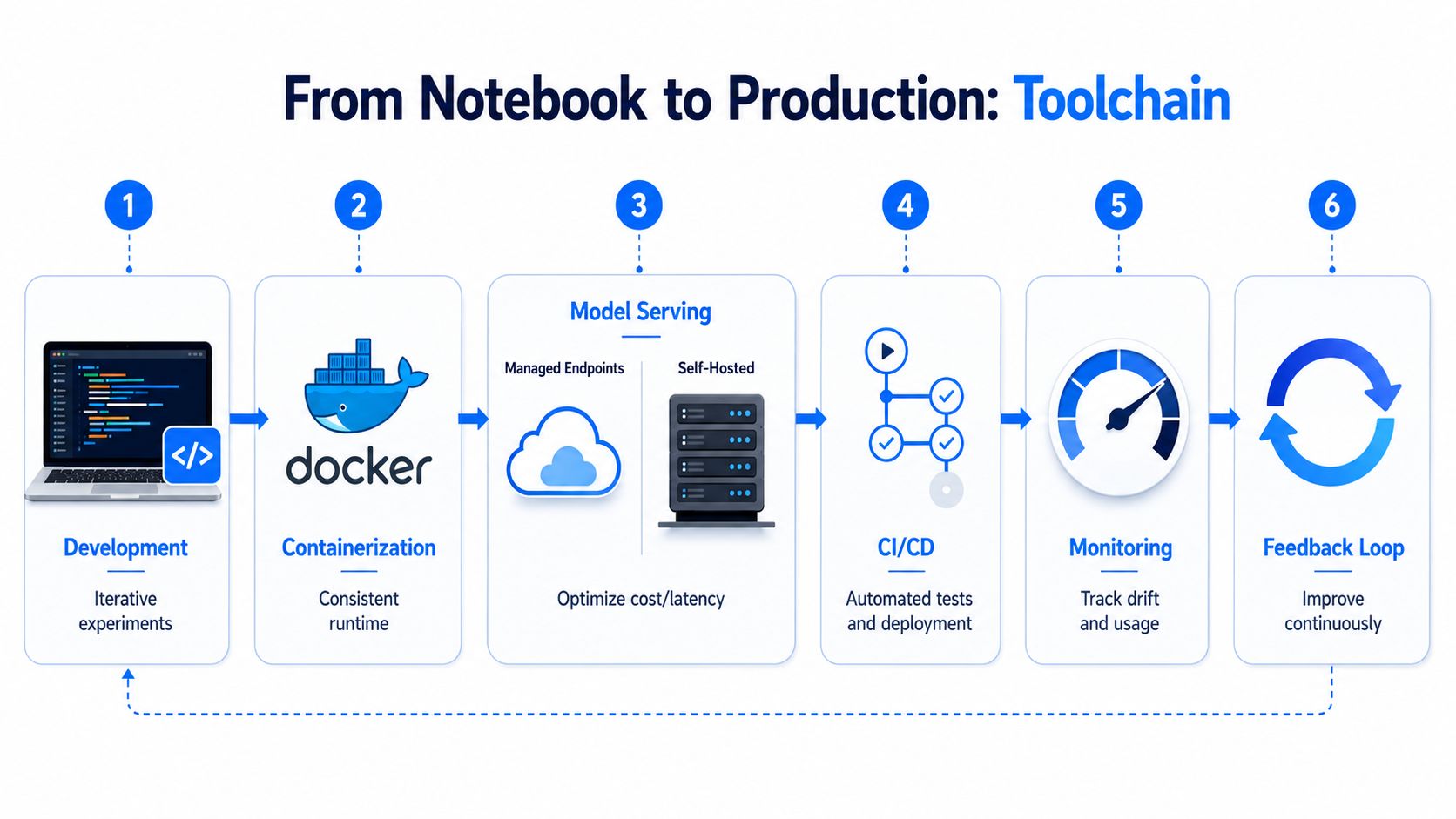
A realistic production stack
Model serving usually starts with managed endpoints or self-hosted services on AWS SageMaker, Azure ML, or GCP Vertex. For hosted LLM access, teams commonly route through Bedrock, Azure OpenAI, or direct API keys, but the delivery choice should follow policy, not vendor hype. For retrieval, vector stores such as pgvector, Pinecone, or Qdrant handle document grounding, while orchestration frameworks like LangChain and Semantic Kernel manage prompts, tools, and retrieval steps.
The workflow begins with a data audit and use-case prioritisation. That is where the team checks whether the data is clean enough, whether the system boundary is clear, and whether the business problem is narrow enough for a first release. A two-to-four week pilot on a closed dataset is usually enough to expose integration mistakes without overcommitting.
A helpful video walkthrough of the engineering mindset sits below.
What production hardening looks like
Production hardening means setting latency budgets, cost guardrails, and evaluation harnesses before the feature goes live. It also means deciding how prompts are versioned, what gets logged, and when human review interrupts automation. After launch, monitoring needs drift detection, usage tracking, and feedback loops from real users, because models decay in ways notebooks never reveal.
UK data residency often nudges teams towards regional endpoints or tightly controlled gateway patterns. In practice, that changes the workflow again, because a compliant architecture usually needs identity-aware access, policy enforcement, and route control around the model call. LAD's software development consulting page is relevant here because this kind of work is as much architecture and delivery discipline as it is model selection.
Tooling only matters when it shortens the path from test to trust. If the stack makes governance slower, the business will bypass it.
Governance, GDPR and UK Regulatory Considerations
Governance is a design constraint, not paperwork bolted on after the pilot. In the UK, any AI system that processes personal data falls under UK GDPR and the Data Protection Act 2018, and the ICO expects that to apply across foundation models, automated hiring tools, and facial recognition systems. That means lawful basis, data minimisation, purpose limitation, and data subject rights all shape the integration from the start.
Why the regulatory shape changes the build
AI introduces extra pressure around automated decision-making, especially where model outputs influence customers or staff. The architecture therefore needs human oversight, traceability, and explainable decision support when the output affects a meaningful outcome. Teams that ignore those basics usually end up retrofitting controls later, which is slower and more fragile than designing them in.
Sector regulators add their own expectations. The FCA matters in financial services, the MHRA matters where health-related models touch regulated workflows, and Ofcom matters where content generation falls into regulated communications or platform contexts. If you need a practical companion piece, digna's guide for data engineers on AI compliance is useful because it focuses on the controls engineers have to implement.
Controls that belong in the architecture
The useful controls are concrete. Prompt and response logging helps with traceability, retention windows limit exposure, role-based access protects sensitive workflows, model cards document assumptions and limitations, DPIA templates force risk review, and human-in-the-loop checkpoints stop unsupported automation from crossing policy lines.
| Regulator | Typical project trigger | Evidence teams should prepare |
|---|---|---|
| ICO | Any use of personal data in model inputs, outputs, or logs | DPIA, lawful basis, retention policy, access controls |
| FCA | Financial advice, transaction monitoring, customer handling, or operational decision support | Audit trail, escalation rules, testing evidence, governance sign-off |
| MHRA | Health-related models that influence clinical or regulated support workflows | Validation evidence, risk controls, change history, review process |
| Ofcom | Content generation or moderation in regulated communications settings | Content policy, logging, moderation logic, oversight records |
The UK's pro-innovation model matters because it signals that deployment is expected, but under existing legal frameworks and sector regulation rather than a single horizontal AI law. That is a practical design cue, not a slogan. It tells teams to build governance into the system boundary and treat compliance as part of delivery, not a separate queue.
Measuring ROI From AI Integration Projects
The cleanest ROI measure is process performance, not generic AI usage. The metrics that recur across UK deployments are average handling time, first-contact resolution, manual hours removed per week, and error or rework rate. If those don't move, the integration has probably created activity rather than value.
Three scenarios that hold up in review
| Scenario | Baseline metric | Expected uplift | Calculation template |
|---|---|---|---|
| Contact centre summarisation and suggested replies | Average handling time | 18 to 25 percent reduction | Baseline handling time × interaction volume × labour cost per minute |
| Invoice extraction for finance operations | Manual hours per week | Around 40 manual hours removed per week | Hours removed × loaded hourly cost × number of working weeks |
| Transaction monitoring support | False positives and analyst time | Lower false positives and more analyst capacity | False positives removed × review time × cost per case |
A contact centre team gets the strongest case when summarisation and suggested replies are embedded directly into the CRM, because agents spend less time stitching together context. A finance team gets the clearest savings when invoice extraction feeds the downstream workflow without a human rekeying the data. A risk team gets value when anomaly detection reduces false positives and frees analyst attention for higher-risk cases.
The calculation discipline that keeps the business case honest
The baseline has to be measured in the pilot, not guessed afterwards. That means capturing current handling time, current rework rates, and current manual effort before the AI goes live. The business case then becomes simple arithmetic, not optimism.
If you want to see how delivery evidence is usually presented, the case studies page is a useful reference point because ROI claims only matter when they're tied to a real workflow and an actual baseline.
ROI rule: Measure the process first, automate second, and compare against the same workload mix after go-live.
Choosing a Delivery Model and Avoiding Common Pitfalls
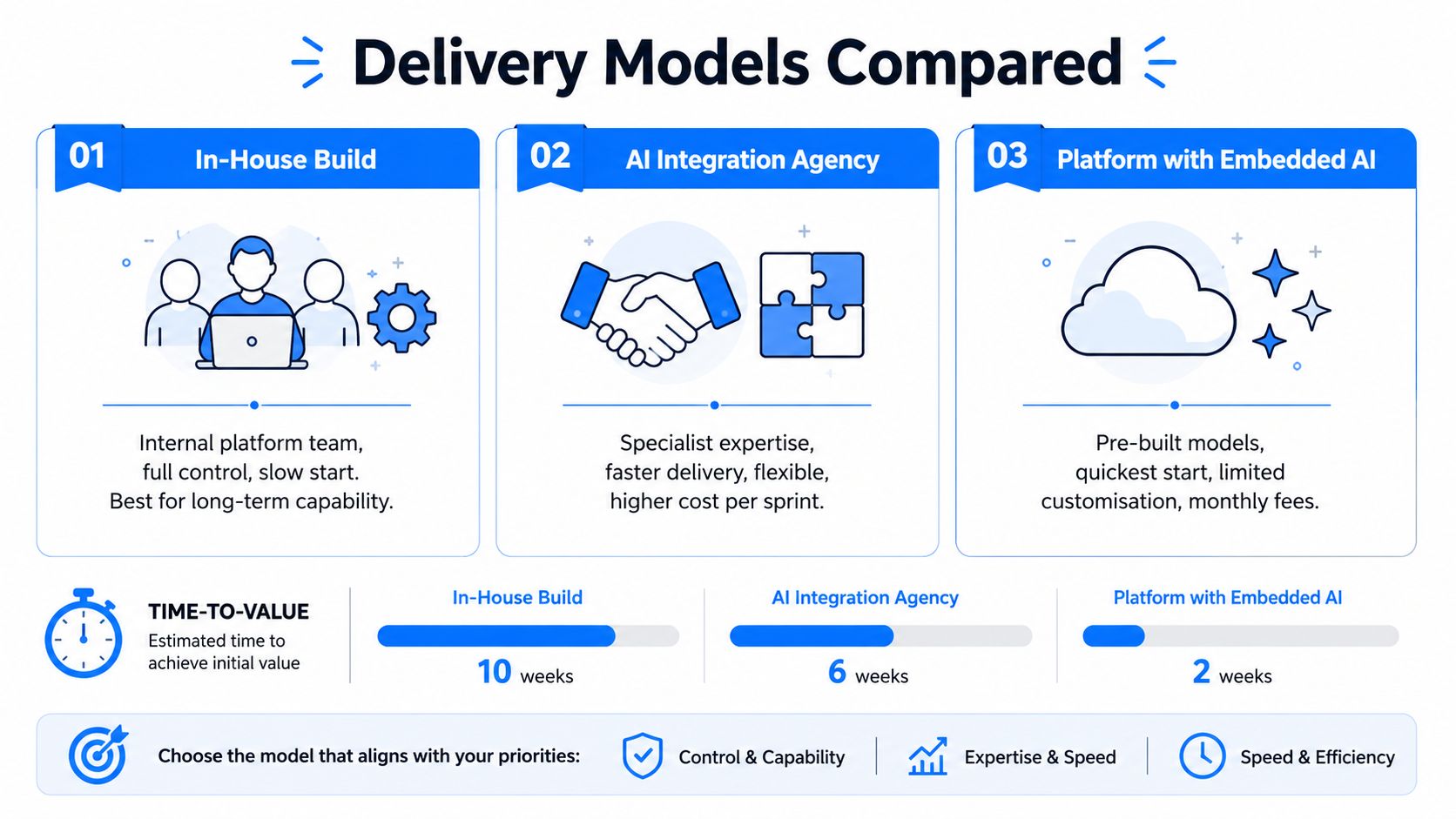
The right delivery model depends on data sensitivity, internal engineering depth, time-to-value, and ongoing total cost of ownership. In-house builds suit teams with strong platform engineering and a long runway. Specialist agencies suit teams that need a faster path through architecture, integration, and governance. Platform vendors with embedded AI suit teams that need quick activation and can live with tighter customisation limits.
How the choice plays out in practice
A regulated fintech wiring a retrieval-augmented chatbot into Salesforce usually needs specialist integration discipline, because CRM context, permissions, and audit trails all matter at once. A retailer adding demand forecast automation to an ERP can often move faster if the internal data team already understands planning workflows. A council trialling a planning application triage assistant often benefits from a narrow pilot with very explicit escalation rules and human review.
LAD's software development consulting page fits this decision space because the work is often about choosing the delivery shape before anyone writes production code. One option among others is to pair in-house ownership with external integration support, which gives internal teams control without forcing them to build every connector from scratch.
The first 90-day pitfalls
The common mistakes are predictable. Teams underestimate data readiness, skip stakeholder review, treat prompts as production code, ignore model drift, and bypass the DPIA. Each one creates a different kind of failure, from broken outputs to governance blocks to silent degradation after launch.
The practical mitigation is a pre-build readiness checklist and a named escalation rule for production rollout. If the pilot meets the agreed process metric, passes review, and the control evidence is complete, expand it. If any of those conditions fail, fix the pipeline before broadening the scope.
A simple decision rule keeps the conversation grounded, use an in-house build when the capability is strategic and the engineering team is mature, use a specialist agency when the integration surface is complex and the deadline is tight, and use an embedded platform when the workflow is standardised and speed matters more than deep customisation. That keeps the first 90 days focused on delivery, not platform theatre.
If you're planning an AI project that has to work inside UK systems, under UK GDPR, with real users and real audit expectations, start with the workflow and the controls, not the model demo. Speak to a delivery team that understands CRM, ERP, API integration, and governance together, then ask them to map the pilot, the rollout path, and the evidence you'll need before go-live.