


About 20% of new UK businesses fail in their first year, around 40% fail by year three, and roughly 58% have ceased trading by year five, according to UK business survival data cited from ONS-based reporting by ByteSizeMe's analysis of UK startup failure rates. That's why learning how to build an MVP isn't primarily an engineering exercise. It's a disciplined way to discover whether customers need your product, will use it repeatedly, and will pay for it before you commit to the full cost of development.
A weak MVP is a small product. A strong MVP is a validation system. It tests one risky commercial assumption at a time, records what users do, and gives the team evidence to decide whether to continue, change direction, or stop.
Why Most MVPs Fail Before a Line of Code Is Written
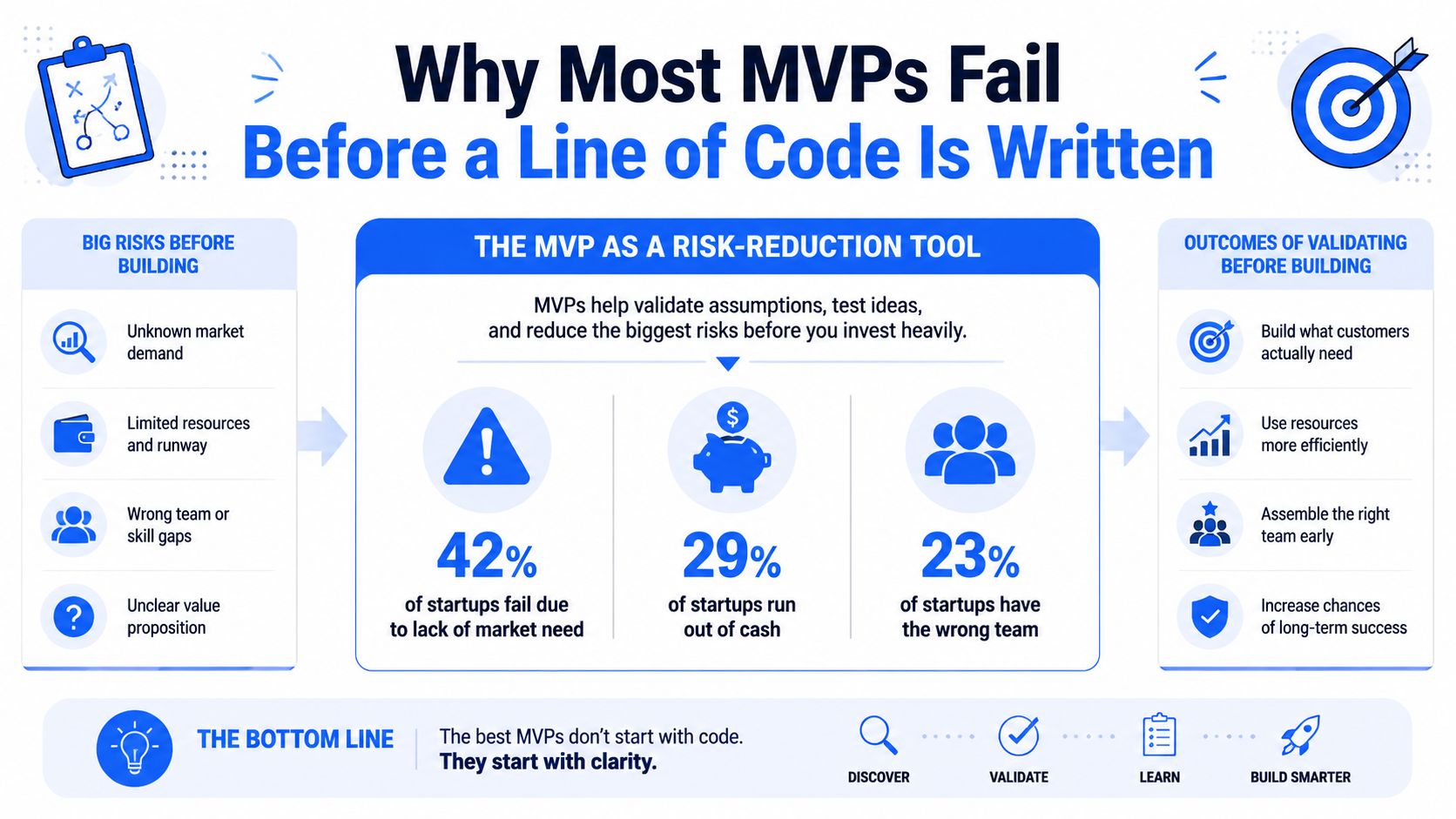
Most MVPs fail before development because founders choose features before proving that a sufficiently painful problem exists. Product teams often treat speed of delivery as the main objective, but a fast build still wastes money when it solves a problem customers don't prioritise.
UK startup reporting based on CB Insights data commonly attributes 42% of startup failures to a lack of market need, as included in UK startup survival and failure analysis. That figure changes the purpose of an MVP. The first release isn't a cheaper version of the finished product. It reduces the risk of investing in engineering, design, integrations and scaling before the market has earned that investment.
Building features is not the same as proving value
A feature answers, “What does the product do?” Validation answers, “Does anyone care enough to change their behaviour?” Those questions require different evidence.
A polished onboarding flow, account system and notification centre might demonstrate that your team can ship software. They don't demonstrate that a customer will return after the first session or pay for the outcome. An MVP should therefore expose the smallest complete path from a user's problem to a useful result. Everything outside that path remains a hypothesis.
UK founders also face a scale problem. The UK government's SME Digital Adoption Taskforce report describes a market of 5.5 million SMEs, a substantial opportunity that remains highly fragmented. Building for “all UK SMEs” produces vague requirements, conflicting workflows and a bloated roadmap. Building for one defined customer group gives interviews, prototypes and usage data a clear context.
Practical rule: If you can't name the first user group, the repeated problem and the observable result, you aren't ready to define the MVP.
Product-market fit is only the first hurdle
Finding demand doesn't automatically create a scalable company. McKinsey's UK analysis reports that 78% of companies that successfully built a product and found product-market fit still fail to scale. The implication is important. An MVP must generate learning about the operating model as well as the user interface.
Founders should ask whether the service can be delivered reliably, whether support requirements are manageable, whether the acquisition route is repeatable and whether the product produces usable behavioural data. A concierge workflow might validate demand while humans handle fulfilment, but the team must record which parts later require automation.
The defensible sequence is simple: prove a narrow need, prove repeated use, then investigate whether the business can deliver that value consistently. Launching less isn't a shortcut around strategy. It is often the most responsible way to avoid building a larger failure.
How to Validate Demand Before You Build Anything
The best way to validate demand is to investigate the problem first, then test whether people will take a meaningful action before you write production code. A founder who starts with screens usually gets feedback about the screens. A founder who starts with the customer's current behaviour learns whether the problem deserves a product.
Start with problem discovery
Run conversations with people who match the proposed customer profile. A UK founder guide recommends 20 to 30 target-user conversations and distinguishes problem validation from general market research in its MVP development guidance. The purpose isn't to collect compliments about an idea. It's to understand what people do now.
Ask questions such as:
- Explore the last occurrence: “Tell me about the last time this problem happened.”
- Trace the workaround: “How did you handle it, and which tools or people were involved?”
- Expose the consequence: “What did the delay, error or manual effort prevent?”
- Test existing spend: “What do you currently pay to reduce this problem?”
- Understand urgency: “What would make you address it this month rather than later?”
Don't describe your proposed solution at the start. If you pitch the product, interviewees often become polite design reviewers instead of truthful customers. Listen for repeated pain, awkward workarounds, budget already allocated and a clear reason the current approach no longer works.
A separate UK business idea validation guide identifies repeated pain, clumsy workarounds and willingness to pay as useful signals, with a practical threshold of five-plus interviews confirming the same pain. Treat that as a gate for stronger investigation, not as proof that the market is ready.
Test commitment, not enthusiasm
A landing page with a clear problem statement and email signup tests interest. A fake door tests whether users select an option when they expect an outcome. A pre-order, deposit or paid pilot tests a more serious form of commitment.
These experiments should state who the product serves, what problem it addresses and what happens after the visitor acts. Track the action that matters, such as requesting a conversation, booking a demonstration or submitting payment details. Don't treat page visits or social reactions as demand evidence on their own.
The strongest early signal is a customer changing behaviour, not a customer agreeing that your idea sounds useful.
Use software development consulting from London App Development when the validation evidence is unclear but the technical implications need an early, independent assessment. A consultant should help separate a commercial question from an implementation question, not turn an untested idea into a large specification.
The result of this stage should be a decision. Proceed when the same urgent problem appears repeatedly and target users take a meaningful action. Rework the proposition when people recognise the problem but reject the proposed commitment. Stop when the problem remains hypothetical or the audience shows no reason to change.
Defining Core Features That Prove Value
The core features of an MVP should support one complete workflow that delivers the primary customer outcome. Start with the validated problem, describe the desired change, and remove every feature that doesn't help the user reach that change.
Write the workflow as a sequence rather than a feature list. For example: a customer submits a request, the system matches it to an available provider, the provider confirms, and the customer receives a usable result. If the MVP stops after submission, it tests intent but not value. If it includes loyalty points, advanced reporting and team permissions, it tests too many assumptions at once.
Prioritise evidence over completeness
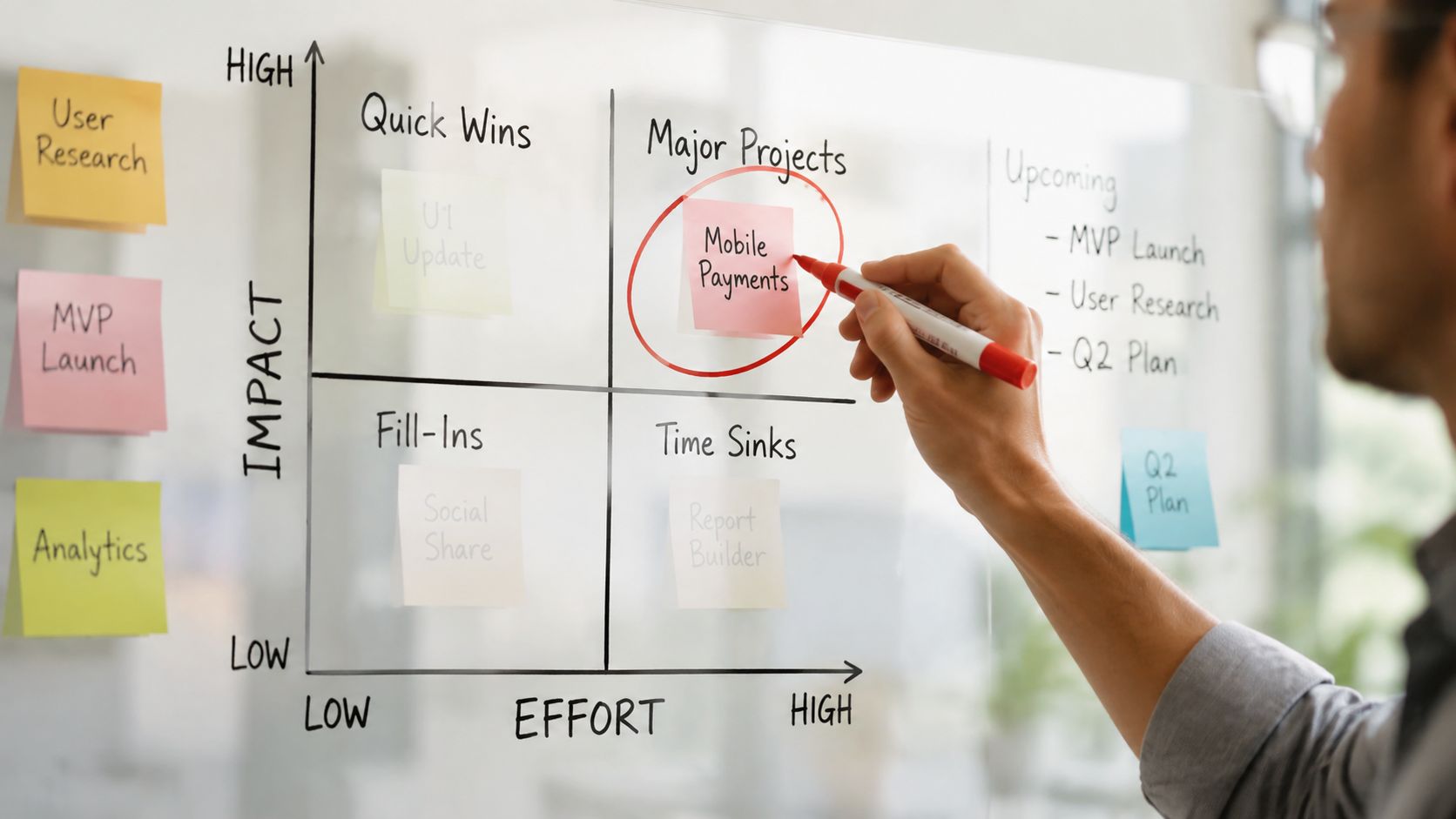
Place candidate features on an impact and effort matrix, then challenge the assumptions behind the highest-impact items. Keep a feature when it helps the user complete the core job, reduces a material risk, or creates evidence for a specific decision. Defer it when it mainly improves polish, accommodates an edge case or supports a future segment.
A useful scope test asks three questions:
- What user action does this feature enable?
- What hypothesis does that action test?
- What decision will the result change?
If the team can't answer all three, the feature doesn't belong in the first release.
London App Development's MVP development service is one route for turning a validated workflow into a constrained delivery plan. Whether you use an agency, internal team or freelancers, keep ownership of the hypotheses and acceptance criteria. Outsourcing implementation doesn't outsource product judgment.
Define success before development
Write measurable hypotheses before the backlog becomes detailed. A hypothesis might state that a defined user group will complete a particular workflow, return to repeat it, or take a commercial action. The exact target depends on the product, but the event must be observable in analytics or recorded by the team.
Define the minimum instrumentation alongside the feature:
- Activation event: the action showing that a new user reached initial value.
- Core usage event: the behaviour that demonstrates the workflow is being used.
- Retention event: the return behaviour that indicates continuing relevance.
- Commercial event: the action linked to payment, booking or qualified demand.
- Failure event: the point where users abandon, encounter an error or request support.
Also record constraints that affect later decisions, including security, hosting, support, data handling and integrations. UK government guidance says an MVP should contain the core elements of an offer, remain quick and cost-effective, and test the market through real-user feedback before scaling in its guidance on testing and validating a business idea.
The best feature list is short enough to defend in one meeting and specific enough to measure after launch.
Prototyping and Choosing the Right Technology
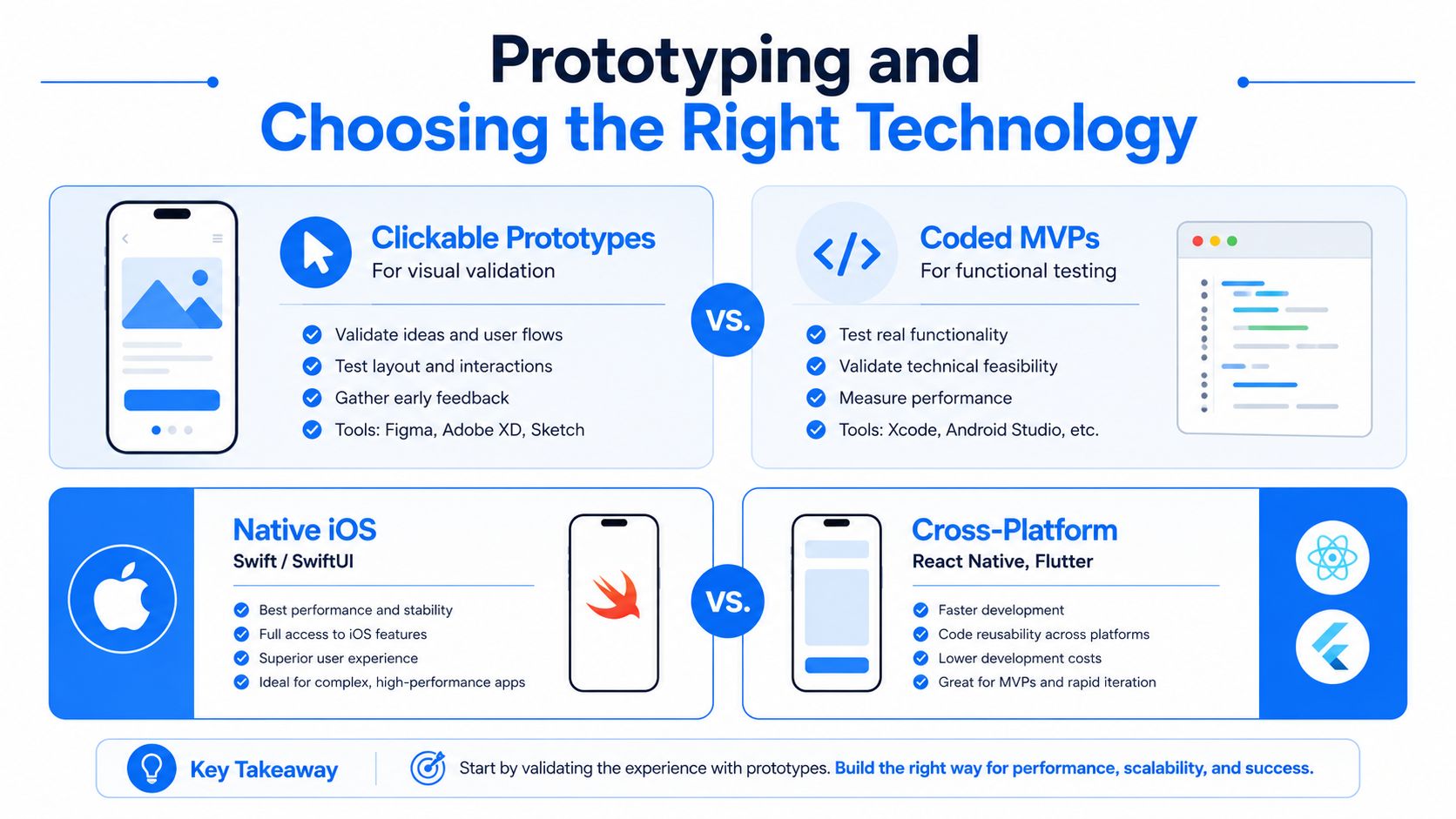
A clickable prototype is the right choice when you need to validate understanding, navigation and perceived usefulness. A coded MVP is necessary when the proposition depends on real data, timing, device capability, payments, integrations or repeated behaviour. Choosing between them depends on the question you need answered, not on the stage label attached to the project.
Clickable prototypes and coded MVPs
A Figma prototype lets users tap through screens, react to wording and reveal where the journey breaks. It is fast to change and useful for moderated usability sessions. It doesn't prove that an API responds correctly, a payment completes, a location service performs reliably or users return without a researcher present.
A coded MVP tests behaviour in a live or controlled environment. It takes more effort, but it creates evidence about real workflow completion, technical dependencies and operational support. Avoid coding merely to make the idea feel real. Code only when a non-functional test can't answer the next commercial question.
Native and cross-platform choices
Native iOS development with Swift and SwiftUI provides direct access to Apple capabilities and a platform-specific experience. Native Android development with Kotlin gives the same advantage within Google's ecosystem. Native work suits products where performance, complex device functions, platform conventions or deep hardware integration influence the customer outcome.
Cross-platform development with Flutter or React Native shares more of the application across iOS and Android. That approach often reduces duplicated implementation and supports a faster route to testing both platforms, although teams still need to handle platform-specific behaviour, release requirements and native integrations.
| Decision factor | Native approach | Cross-platform approach |
|---|---|---|
| Platform fit | Strong when one operating system drives the initial audience | Useful when both platforms matter early |
| Device capability | Direct access to specialised features | Suitable for common capabilities, with native extensions when required |
| User experience | Closely follows platform conventions | Maintains a shared product experience across platforms |
| Delivery model | Separate platform expertise and implementation | Shared application code with platform-specific testing |
The UK SME market is broad but fragmented, so platform selection should follow the first customer segment rather than an assumption that every user needs every platform on day one. Review distribution, device usage, security requirements and integration complexity before choosing the stack.
For teams considering shared mobile development, London App Development's cross-platform app development service covers Flutter and React Native as delivery options. The technology decision remains a product decision. A faster framework doesn't rescue an unvalidated workflow, and native performance doesn't compensate for weak demand.
From Development Sprints to Launch in 13 Weeks
A practical UK startup MVP schedule runs through four delivery phases across 13 weeks: discovery and scope in weeks 1–2, design and prototype in weeks 3–5, development sprints in weeks 6–10, and quality assurance, beta and launch in weeks 11–13, as outlined in this UK MVP app development framework.
Weeks 1–2 establish the contract with reality
The team confirms the target user, core workflow, assumptions, risks, technical constraints and success events. The output should include a prioritised scope, an agreed prototype or build decision, an analytics plan and acceptance criteria.
The phase exits when the team can explain what the MVP will test and what it will deliberately exclude. If stakeholders still add features during discovery, the project doesn't have a stable product boundary.
Weeks 3–5 turn the workflow into a testable experience
Design the smallest journey that delivers the promised result. Use a clickable prototype for usability sessions, then revise navigation, language and error handling before engineering begins. Include empty states, failed actions, permissions and support routes, because users experience those conditions as part of the product.
The phase exits when representative users understand the journey and the team has resolved the highest-risk interaction problems. Don't spend the period polishing every screen while the core task remains ambiguous.
Weeks 6–10 build in vertical slices
Each sprint should produce a working part of the end-to-end workflow, not an isolated collection of screens. Connect the interface to the necessary services, implement analytics events as behaviours are added, and keep an internal build available for review.
Prioritise reliability around the core action. Defer secondary dashboards, complex settings and broad administrative tooling unless they directly support delivery or measurement. A thin but complete workflow teaches more than a wide application full of disconnected features.
For teams that need a structured engineering partner, London App Development's product development service describes an end-to-end route from product definition through software delivery. Keep sprint reviews focused on evidence and working behaviour rather than the amount of code produced.
Weeks 11–13 expose the product to real conditions
QA should test the critical workflow, permissions, data handling, integrations, failure paths and analytics accuracy. A beta group then uses the product in context, while the team records support requests, abandonment points and unexpected workarounds.
The launch decision should depend on whether the MVP can deliver its stated outcome safely and measure the defined hypotheses. Launching doesn't mean declaring success. It starts the evidence-gathering phase that determines the next product decision.
Measuring Success and Iterating After Launch
An MVP succeeds when it produces reliable evidence for a commercial decision, not when it attracts attention. Instrument activation, core usage, retention, conversion and failure events from the first usable build, then examine what different user groups do over time.
Measure behaviour that changes the roadmap
Vanity metrics such as downloads, page views and total registrations provide context but rarely answer whether the product creates continuing value. Activation shows whether new users reach the first useful outcome. Retention shows whether that outcome remains relevant. Conversion shows whether the commercial proposition survives contact with a buying decision.
Create cohorts based on a meaningful starting event, such as signup week, customer type or acquisition route. Compare how those groups progress through the core workflow and where they stop. A single blended dashboard can hide the difference between a product that works for one narrow audience and a product that works for nobody consistently.
Measurement principle: Every tracked event should support a decision about what to improve, remove, investigate or scale.
Treat support and operations as product evidence
Record the questions users ask, the tasks staff complete manually and the failures that require intervention. Those observations reveal where the product's promise depends on hidden human effort. They also show which automation would create genuine efficiency and which automation would merely add complexity.
Plan iteration funding before launch. A UK cost and timeline guide reports that annual post-launch support often represents 15–20% of the original budget, while its 2026 delivery ranges cover 1–6 weeks for discovery and design, 6–20 weeks for the build, and 2–8 weeks for launch and measurement in its MVP development guidance. These figures are planning ranges, not guarantees, so use the product's risk, integrations and compliance needs to shape the estimate.
Choose pivot, persevere or scale
Pivot when users encounter the problem but reject the proposed solution or commercial model. Persevere when a defined segment completes the core workflow and returns, while important friction remains solvable. Scale when demand is repeatable and the team understands the operational cost of delivering the outcome.
The UK government's digital identity sector analysis reports sector GVA of about £1.037 billion across 275 firms, up £149 million year on year. That context illustrates why trust-sensitive products require more than a launch checklist. Identity, privacy, security and auditability need measurement and operational ownership from the beginning.
Learning speed matters more than build speed. A smaller product with clean events, honest customer conversations and a funded iteration loop gives founders the evidence to make the next investment responsibly.