


Your finance team rekeys invoice data from a procurement portal into an ERP. Customer service checks one CRM, operations checks another, and neither team sees the full history. Every department holds part of the truth, but no process joins it together reliably.
Enterprise application integration (EAI) connects an organisation's applications so they exchange data, services and business processes reliably. EAI is more than an API call between two products. It combines integration architecture and governance to make separate applications and systems work as a coordinated environment.
What Does Enterprise Application Integration Mean?
Enterprise application integration is the practice of linking separate business applications so data, processes and services flow between them without repeated manual entry. The connected applications often include an ERP, CRM, finance platform, HR and payroll software, ecommerce systems, warehouse management tools, data warehouses and SaaS applications.
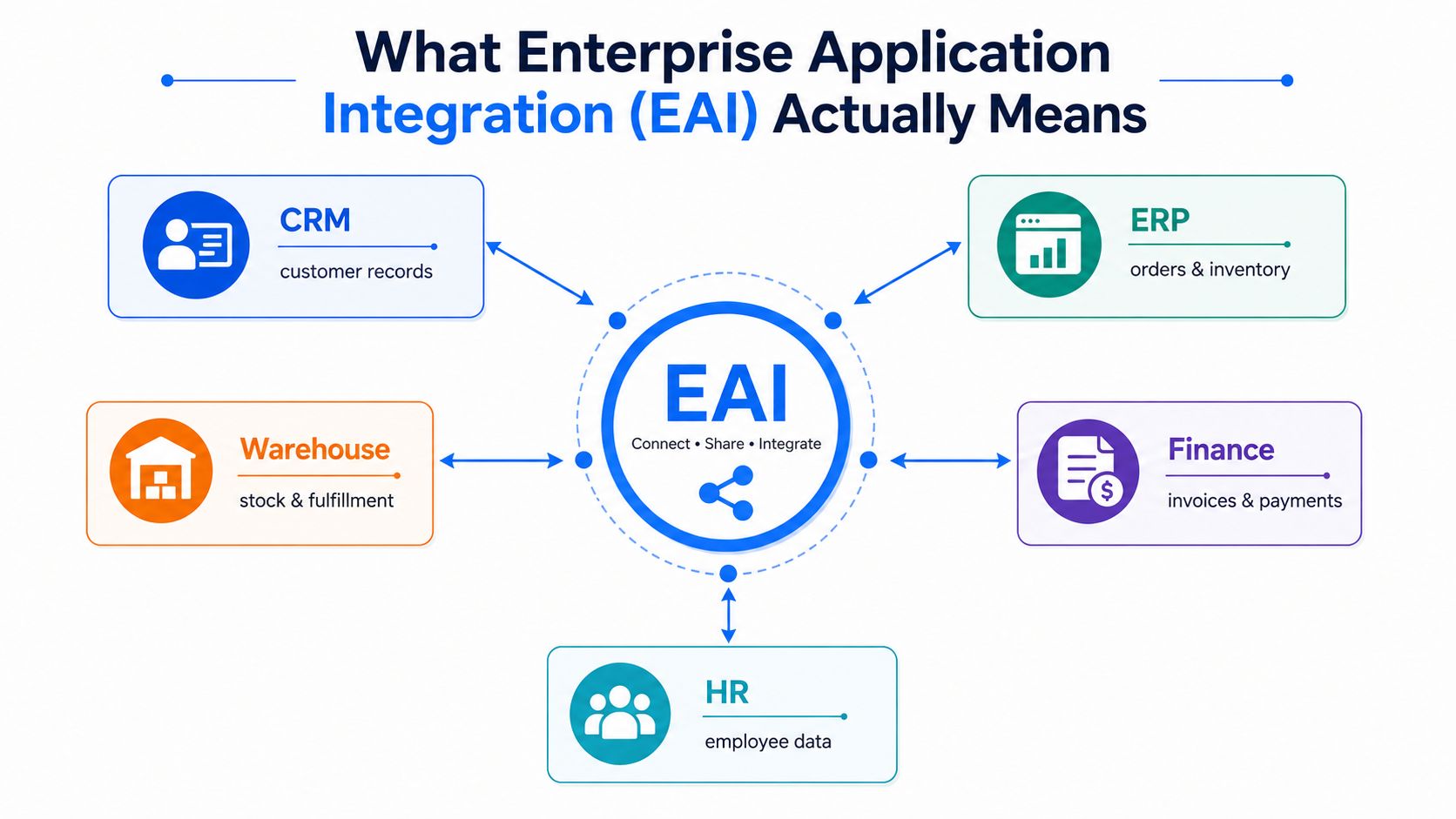
Consider a customer placing an order online. The ecommerce platform records the order, the ERP needs the commercial transaction, the warehouse needs fulfilment details, finance needs an invoice, and the CRM needs the customer interaction history. Without EAI, staff export files, copy values between screens or wait for separate teams to reconcile records.
What Types of Applications Does EAI Connect?
EAI commonly connects five broad types of business applications:
- Core business systems: ERP, CRM and finance platforms.
- People systems: HR, payroll and identity platforms.
- Operational systems: Warehouse, logistics and manufacturing software.
- Customer-facing systems: Ecommerce platforms, portals and contact-centre tools.
- Analytical and cloud systems: Data warehouses, reporting platforms and SaaS products.
EAI synchronises records, triggers actions and passes information between these applications. For example, a new employee record in an HR system triggers an IT provisioning task, a stock change in a warehouse system updates the ecommerce catalogue, and a support case in a CRM creates a task for the engineering team.
How Is EAI Different From Basic Application Integration?
EAI differs from a basic application integration mainly in scope: EAI coordinates multiple applications and business processes, while a basic integration usually connects two systems for a specific task. For example, a simple integration might send leads from a website to a CRM, while EAI defines how data and processes move across multiple systems, teams and workflows.
That wider scope introduces governance, ownership, security, monitoring, data quality and lifecycle management. A script makes two applications exchange fields, but it does not decide which system owns the customer record, how conflicts are resolved or what happens when an endpoint fails.
This is why EAI fits naturally within enterprise software development services for connected systems. The connection matters, but the organisation also needs a maintainable way to change applications without breaking dependent processes.
Why Enterprise Application Integration Matters for Growing Businesses
Enterprise application integration matters for growing businesses because growth multiplies the cost of disconnected systems. When one customer update must pass through CRM, finance, fulfilment and support systems, manual copying and fragile scripts create delays, reconciliation work and inconsistent records. EAI provides shared operational infrastructure for those flows.
The UK system integration market was valued at US$21,836.9 million in 2023 and is projected to reach US$56,132.7 million by 2030, implying a 14.4% CAGR from 2024 to 2030, according to UK system integration market analysis from ITJobsWatch. Application integration, including EAI, ESB and iPaaS solutions, is a primary driver of this growth.
Disconnected systems create six common operational problems:
- Duplicate entry: Staff retype customer, order or invoice details.
- Conflicting records: Teams use different addresses, account statuses or stock positions.
- Slow reconciliation: Finance and operations investigate mismatched totals.
- Weak visibility: Service agents cannot see issues held by logistics.
- Brittle handoffs: Missed emails or failed spreadsheet uploads interrupt work.
- Delayed reporting: Leaders wait for extracts instead of using current operational data.
A deliberate integration approach becomes necessary when several teams build one-off connections, a merger leaves duplicate platforms, or an audit requires records to be traced across systems. It also supports digital products that depend on existing ERP, CRM, identity or payment capabilities. Organisations planning enterprise software development for connected business applications should define ownership, data rules and failure handling alongside the technical connections.
Practical rule: Treat integration as shared operational infrastructure once more than one team depends on the same data flow.
UK requirements add constraints that architecture diagrams often hide. UK GDPR data minimisation means connected systems should receive only the personal data each process needs, not every available field. Public-sector and tax integrations also require attention to HMRC named API mechanisms and GOV.UK's OpenAPI 3 reference architecture. These requirements affect API design, access controls, retention and testing.
UK API research reports that 90% of enterprises in the UK and Ireland said developers would innovate more effectively if API building, management and integration were more connected. 84% said those activities should be handled as one process, as reported in UK enterprise application integration research.
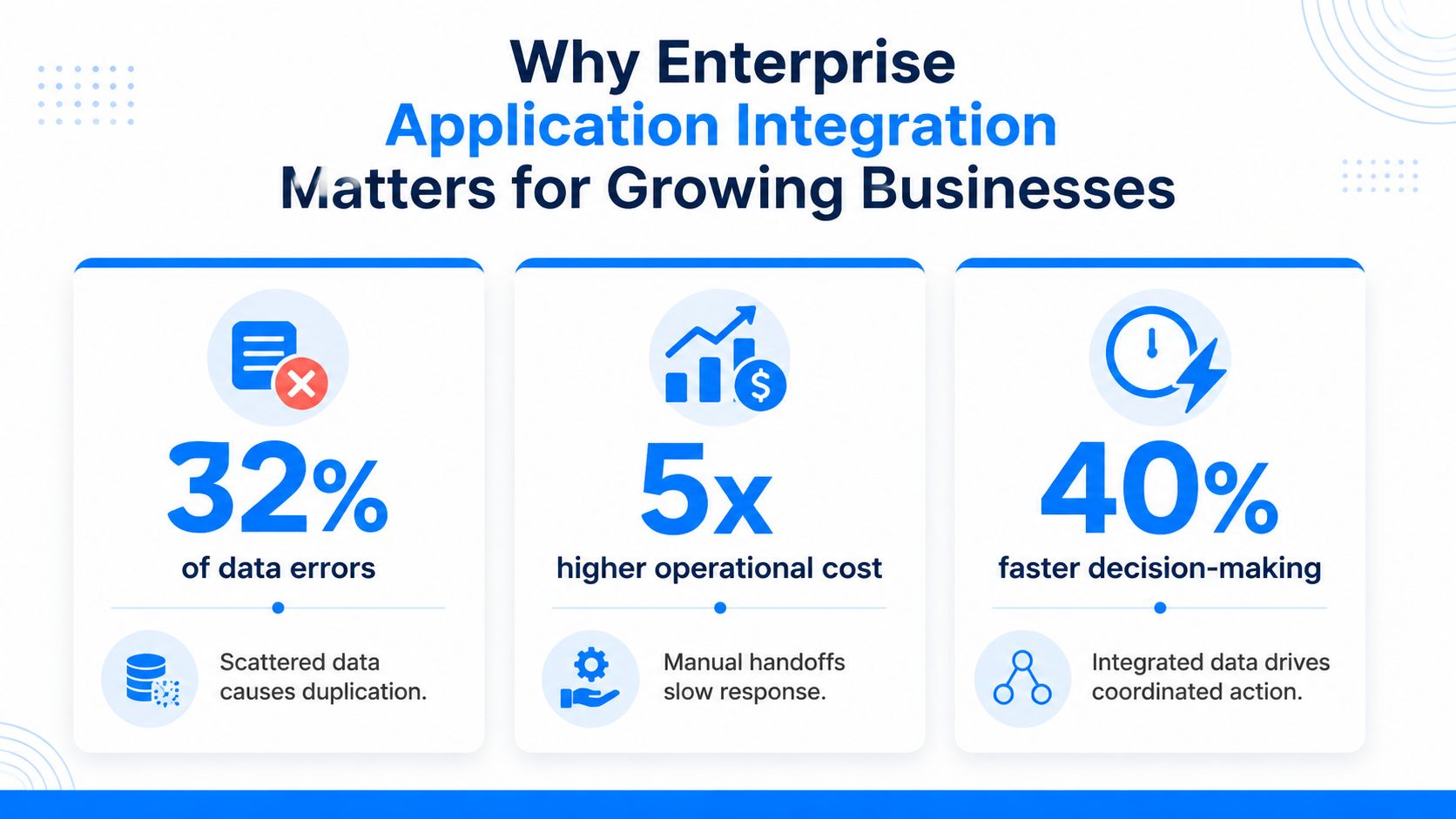
The business case rests on shorter process cycles, fewer reconciliation tasks, reliable reporting and easier system change. It also needs to account for API charges, legacy constraints and scarce integration skills. EAI makes a chosen process repeatable and observable, but it does not repair a poor process by itself.
How Enterprise Application Integration Works Behind the Scenes
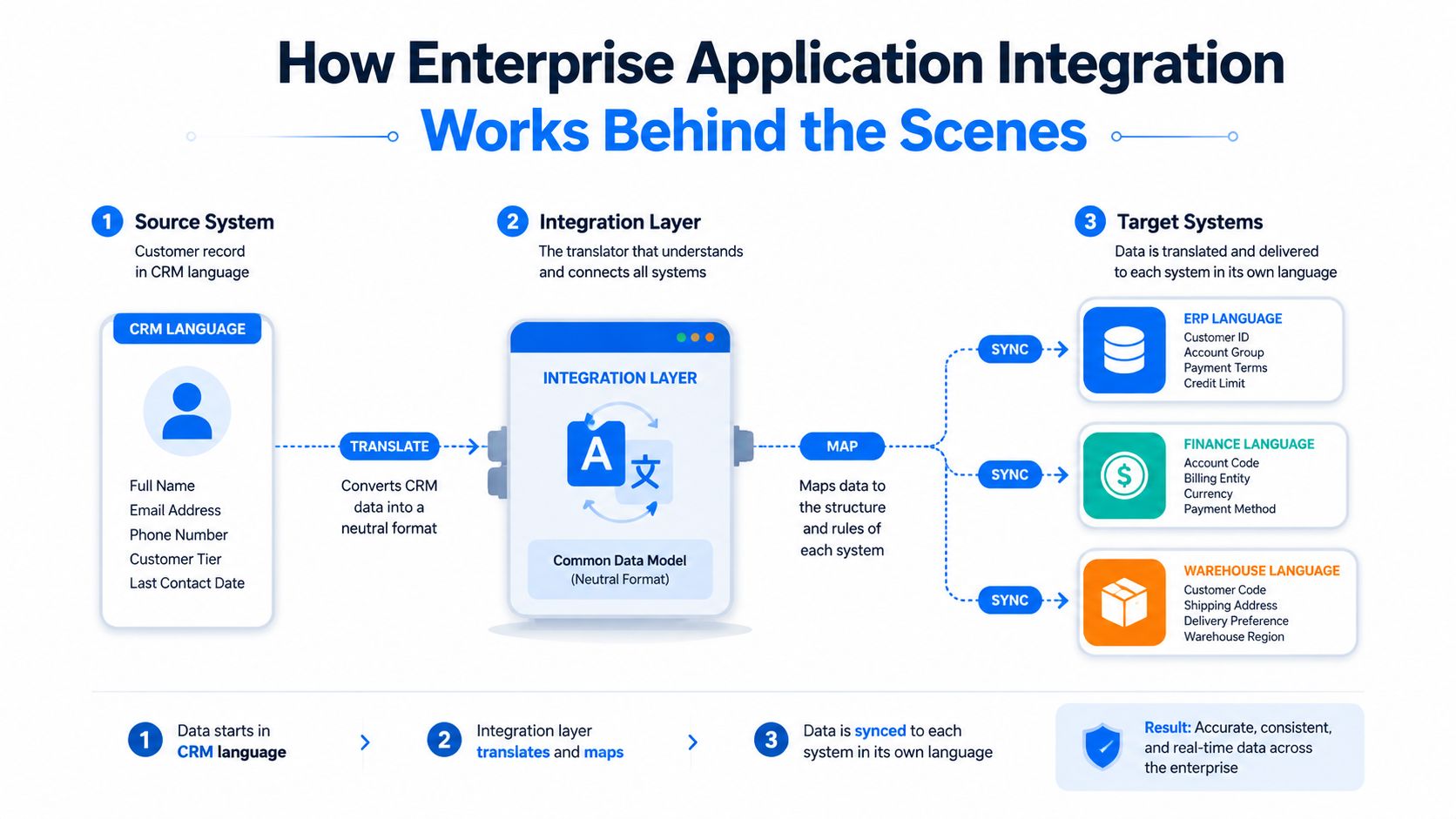
Enterprise application integration works by placing a translation and coordination layer between applications that use different data structures, protocols and business rules. A CRM record often describes a customer one way, while an ERP, finance system and warehouse use different field names, identifiers and status values.
How Does Middleware Support Application Integration?
Middleware supports application integration by receiving messages, applying rules, routing them to the correct destination and recording what happened. It also handles protocol mediation, authentication, retries and queuing.
A useful mental model is a translator in a meeting. The translator does not merely replace words. The translator preserves meaning, accounts for context and delivers the result to the right person. Middleware performs the same function for applications.
What Role Do APIs Play in EAI?
APIs play a central role in EAI because APIs expose the capabilities that integrations call, such as retrieving a customer, creating an invoice or updating an order. A connector uses that interface to authenticate, send requests, receive responses and interpret errors.
A synchronous flow waits for a response, which suits immediate validation or lookup. An asynchronous flow places a message on a queue or publishes an event, which separates systems and absorbs temporary failure or burst demand.
GOV.UK's reference architecture requires teams to provide documented APIs, use OpenAPI 3 to document REST APIs, produce data using the Open Standards Principles and use open standard formats, as set out in the GOV.UK data and APIs reference architecture. These requirements make interfaces easier for other systems to discover and consume.
How Do Connectors and Data Transformation Work?
Connectors and data transformation work by translating a source payload into the destination model and then executing the required business flow. A connector knows how to communicate with a particular application. Transformation maps the source payload into the destination structure. For example, customer_reference becomes account_id, while a source status such as “confirmed” becomes a destination status such as “ready for fulfilment”.
An integration flow also needs orchestration. It validates the order, reserves stock, creates an invoice and notifies the CRM in sequence. If the warehouse call fails, the platform should record the failure, retry where appropriate and stop a partial process from becoming an unexplained data discrepancy.
Teams working on customer data flows often benefit from this guide to CDI architectures and best practices, especially when they need to separate application synchronisation from broader customer-data management.
EAI runs on premises, in the cloud or across a hybrid estate. The important point is that it is not one product. It is a stack of interfaces, connectors, transformation rules, message handling, orchestration, security and observability.
The Main Enterprise Application Integration Patterns Compared
The main EAI patterns differ in where they place routing, transformation and governance. The right choice depends on the number of systems, legacy constraints, data sensitivity, delivery model and internal skills.
Point-to-Point Integration
Point-to-point integration connects one application directly to another. It suits a small, stable workflow with two systems.
The risk appears when every new application creates more direct links. Each connection carries its own authentication, mapping, monitoring and failure behaviour. Over time, teams struggle to identify dependencies or change one system safely.
Hub-and-Spoke Integration
A hub-and-spoke model routes traffic through a central hub. Each application connects to the hub, which handles transformation and distribution.
This reduces direct connections and centralises control, but the hub becomes a bottleneck or a critical failure domain if it accumulates too much traffic or logic. Teams also need to prevent the hub from turning into an unstructured collection of special cases.
Enterprise Service Bus
An Enterprise Service Bus (ESB) provides a central messaging backbone for routing, protocol conversion, transformation and orchestration. It suits complex estates with legacy applications, multiple protocols and strict on-premises control requirements.
ESBs demand specialist skills and disciplined governance. A heavily customised bus becomes difficult to change, especially when teams place too much business logic inside it.
API-Led Integration
API-led integration organises interfaces into reusable layers. System APIs expose underlying applications, process APIs combine capabilities into business workflows, and experience APIs shape data for a specific channel or consumer.
This approach supports discoverability and reuse, but it requires API ownership, versioning, documentation and lifecycle management. It involves more than placing an API gateway in front of every application.
Integration Platform as a Service
An iPaaS provides cloud-hosted connectors, workflow design, transformation, runtime services and monitoring. It suits organisations that connect several SaaS applications without operating their own middleware infrastructure.
The trade-offs include subscription costs, consumption-based pricing, platform dependency and possible limits around specialised legacy protocols. Low-code design speeds delivery, but complex rules still require engineers who understand data, security and failure modes.
| Pattern | Core mechanism | Best fit | Skills needed | Key trade-off |
|---|---|---|---|---|
| Point-to-point | Direct connection between systems | Small, stable workflows | Application developers | Becomes difficult to govern as links multiply |
| Hub-and-spoke | Central broker routes connected systems | Controlled multi-system exchanges | Integration and platform engineers | Central hub can become a bottleneck |
| ESB | Messaging backbone with mediation and orchestration | Complex legacy and hybrid estates | Specialist integration engineers | Strong control brings operational overhead |
| API-led | Reusable system, process and experience APIs | Modular services and changing channels | API designers and software engineers | Requires sustained API governance |
| iPaaS | Cloud platform with connectors and managed runtime | SaaS-heavy and cloud-first estates | Platform specialists and capable business users | Subscription cost and vendor dependency |
Mature estates often use a hybrid topology. An iPaaS connects SaaS products, API-led services expose reusable capabilities, and an ESB continues handling a critical legacy workload.
EAI vs ESB vs iPaaS and How They Relate
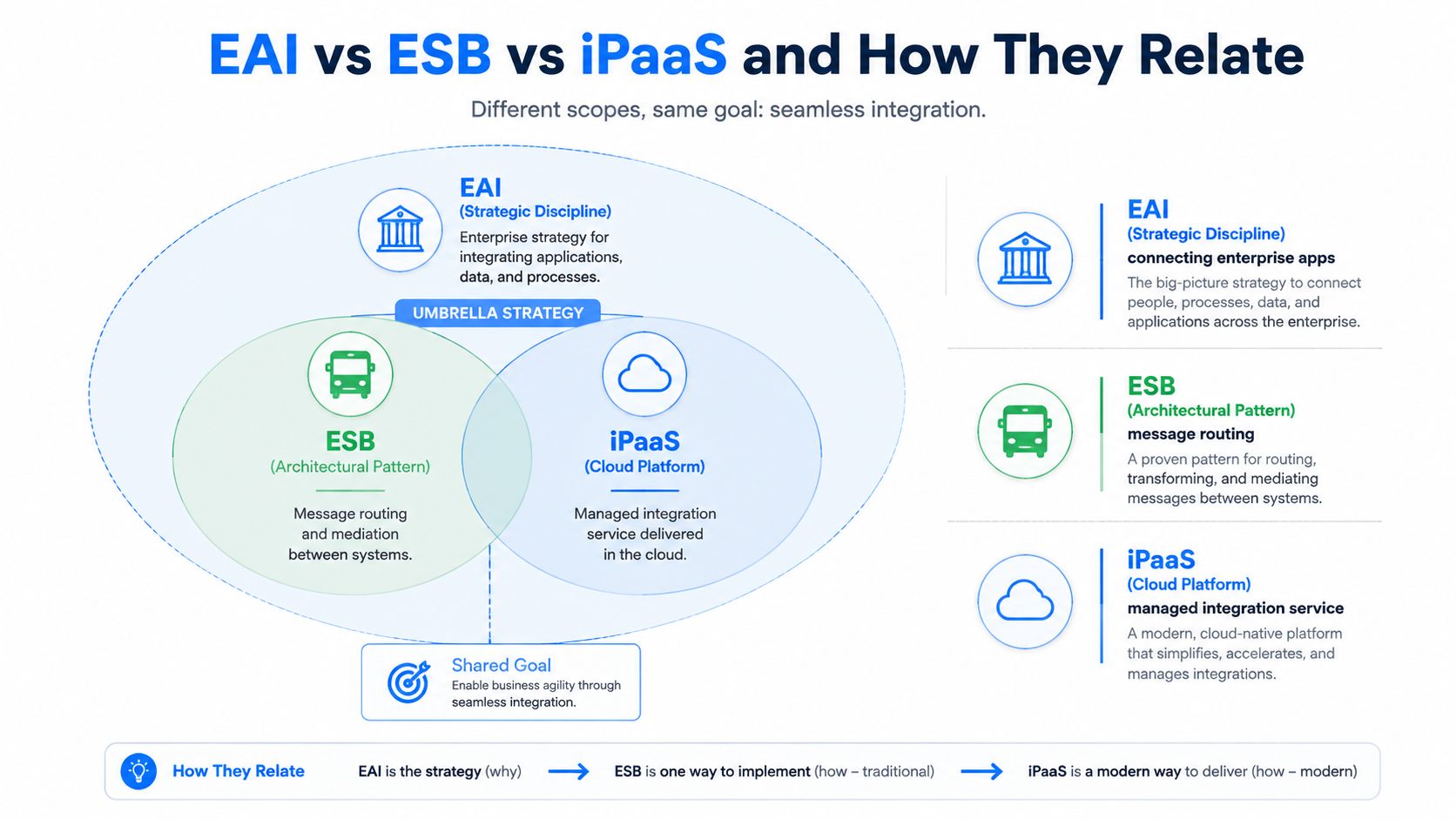
The main difference between EAI, ESB and iPaaS is scope and architectural role. EAI is the broader integration discipline, ESB is an architectural pattern, and iPaaS is a cloud delivery model.
EAI describes the objective and operating model. It includes decisions about systems, data ownership, interfaces, workflows, security, monitoring and governance. It does not require one specific technology.
An ESB is one way to implement EAI. It provides a messaging backbone that routes, transforms and orchestrates exchanges, often with strong control over on-premises and hybrid environments.
An iPaaS packages integration capabilities as a managed cloud service. It provides connectors, transformations, workflow orchestration, API management, logging and alerting without requiring the organisation to run the underlying platform.
Choose based on the problem rather than the label:
- Use an ESB-style approach when deep protocol mediation, central routing and on-premises control are important.
- Use iPaaS when cloud and SaaS connectivity, managed infrastructure and rapid configuration matter most.
- Use broader EAI governance when the estate needs a combination of APIs, events, queues, legacy adapters and data integration.
An on-premises ESB supports an EAI strategy, while an iPaaS provides ESB-like functions as part of a managed service. The terms overlap, but they are not interchangeable.
Real Use Cases, Benefits and Common Challenges
Enterprise application integration creates value when it connects a business process, not just a record transfer. A sales-to-cash flow, for example, links CRM, ERP, billing and finance so teams follow an opportunity from quotation through payment.
Common examples include:
- CRM and ERP synchronisation: Sales teams see order and account information while finance and operations receive the data needed for fulfilment.
- HR and finance integration: Employee changes flow into payroll and financial planning without repeated updates.
- Ecommerce and warehouse integration: Orders and stock changes move between customer-facing and fulfilment systems.
- Legacy system exposure: Middleware or APIs make selected legacy capabilities available to newer applications without replacing the entire platform.
When those workflows require bespoke logic across core systems, a structured ERP software development service for integrated enterprise workflows helps new processes coexist with existing platforms instead of becoming another isolated application.
The benefits are practical. Teams spend less time entering the same information, process owners get clearer status visibility, and finance investigates exceptions from connected records instead of disconnected exports. Integration also makes a legacy replacement less urgent when a carefully designed interface preserves the required capability.
The challenges determine whether those benefits survive production:
- Data model mismatch: Different identifiers, formats and status values create inaccurate mappings.
- Duplicate and conflicting records: Teams need a clear source of truth and conflict policy.
- Legacy limitations: Older applications offer limited interfaces or fragile custom endpoints.
- Security complexity: Each connection adds credentials, permissions and audit requirements.
- Privacy obligations: UK GDPR and the Data Protection Act 2018 require lawful processing, purpose limitation and data minimisation when APIs handle personal data, as explained in UK API compliance guidance.
- Economic overhead: API consumption fees, specialist skills, support and monitoring contribute to total cost.
- Operational resilience: Failed calls, timeouts and partial updates need retries, queues, alerts and reconciliation.
HMRC illustrates why regulated integration needs precise technical decisions. Its third-party software standards support JSON RESTful APIs through the HMRC Developer Hub and XML APIs for specific services where XML remains the only supported method, as described in HMRC's software integration standards.
Implementing EAI and Choosing the Right Platform
Implementing EAI successfully requires treating it as an operating capability, not a connector purchase. Start with an inventory of applications, owners, interfaces, data classifications and business-critical workflows. Trace how records move today, including spreadsheets, manual approvals and undocumented scripts. This often exposes work that a platform does not remove automatically.
Set success measures before comparing products. Track data accuracy, synchronisation status, API response and error rates, availability, failed transactions, processing latency and recovery time after integration failures. These measures connect platform decisions to operational outcomes.
Use a staged delivery sequence:
- Discover the estate: Identify systems, dependencies, owners and regulatory constraints.
- Prioritise flows: Choose a process with clear business value and manageable risk.
- Define the contract: Agree schemas, identifiers, ownership, security controls and failure behaviour.
- Build a controlled proof of concept: Test realistic records, exceptions and downstream effects.
- Operationalise: Add logging, alerting, retry policies, runbooks and named ownership.
- Expand deliberately: Reuse patterns that have worked, while checking that their assumptions still apply.
Platform choice should follow the work. An ESB or hybrid middleware layer suits a legacy-heavy, regulated estate because it supports varied protocols, on-premises deployment, auditability and recovery. The trade-off is specialist skills and slower change. API-led integration suits modular products and changing channels, provided the organisation manages API lifecycles, documentation, versioning and reuse. Treating APIs as unmanaged endpoints creates a new form of fragmentation.
An iPaaS connects many cloud and SaaS tools with less infrastructure to operate. Connector depth, monitoring and security still need testing, while consumption pricing and vendor lock-in change the economics. Event and queue-based services suit operational workflows that need delivery guarantees, ordering or replay, but diagnosis is harder without strong observability. A lightweight integration service is the sensible choice for a small, stable scope, as long as the design has a maintainable exit path.
| Business context | Recommended pattern | Key selection criteria | Watch out for |
|---|---|---|---|
| Legacy-heavy and regulated | ESB or hybrid middleware | Protocol support, on-premises deployment, auditability and recovery | Specialist skills and slow change |
| Cloud-first with many SaaS tools | iPaaS | Connector depth, monitoring, security and usage pricing | Consumption fees and lock-in |
| Modular products and changing channels | API-led integration | API lifecycle, documentation, versioning and reuse | Treating APIs as unmanaged endpoints |
| Event-heavy operational workflows | Event and queue-based services | Delivery guarantees, ordering, replay and observability | Difficult debugging without strong tooling |
| Small, stable integration scope | Lightweight integration service | Simplicity, maintainability and exit options | Outgrowing the initial design |
Evaluate total cost over the expected operating life. Include implementation, platform fees, API usage, support, security review, migration and the skills needed to run the service. The 2025 data and digital roadmap describes public-sector data quality as “inconsistent and frequently poor” and identifies siloed data and sharing agreements as continuing barriers.
The UK government's 2025 state of digital government review states that API costs are a significant barrier to digital transformation. It also reports that only 6% of public-sector IT leaders considered digital transformation fully integrated, while 58% cited workforce skill and talent gaps, 51% cited data privacy and security concerns, and 49% cited limited budgets.
AI-enabled workflows add similar cost and governance questions. UK AI adoption research reports lack of expertise as the top AI adoption barrier at 35%, followed by high costs at 30% and uncertainty about return on investment at 25%. Guidance on AI agent and CRM integration helps teams assess the extra interfaces, permissions and oversight those workflows require.
Organisations assessing new enterprise systems often compare platform capability with custom enterprise software development for long-term architectural fit. London App Development offers enterprise application development and software integration alongside broader application engineering services. The decision should rest on architecture fit, UK GDPR data minimisation, governance, skills and long-term operating cost.
A Practical Example and the Future of EAI
A practical example of EAI is a retailer connecting ecommerce, warehouse, accounting and tax systems through one governed integration design. A UK retailer might connect its ecommerce platform, warehouse system, accounting software and HMRC Making Tax Digital for VAT services through an API-led integration design. The ecommerce platform publishes an order, the integration layer validates and routes it, the warehouse updates fulfilment status, accounting records the invoice, and the tax workflow submits the required VAT information through the permitted interface.
The design must minimise personal data, maintain audit trails and document each exchange. GOV.UK's reference architecture favours open standards, documented APIs, OpenAPI 3 for REST interfaces and open data formats, while HMRC's standards show that a regulated service may support different mechanisms for different services.
The future of EAI combines cloud-native runtimes, event-driven flows, AI-assisted mapping, anomaly detection and low-code configuration. AI suggests mappings or identifies unusual exchanges, but teams still need people to approve data ownership, privacy rules and recovery behaviour.
Open standards are central to the UK's public-sector approach. The GOV.UK Open Standards Principles state that open standards are used to select standards for software interoperability, data formats and document formats in government IT.
The strongest integration strategy does not necessarily use the newest pattern. It matches the organisation's cloud maturity, legacy footprint, regulatory load, engineering skills and risk appetite. Start by mapping your critical systems and data flows, then assess whether your current architecture supports reliable, governed exchange. If you need help designing or implementing that integration backbone, contact London App Development about software integration requirements.
If your teams are rekeying data, reconciling conflicting records or maintaining fragile system-to-system scripts, arrange an integration assessment with London App Development. Bring your application inventory and one high-value workflow, and ask for a documented architecture, data-flow map, security approach and total-cost view before committing to a platform.