


App development in the UK costs about £12,000 to £120,000 or more for a custom app built by an agency. At London App Development (LAD), design costs £4,000 to £20,000, development £8,000 to £100,000 or more, and support after launch £400 to £2,000 a month. A simple app takes 8 to 12 weeks; a large app 6 to 9 months or more.
Your app’s cost depends on four things: how many types of user it has, which features it needs, which platforms it runs on, and what it must connect to. This guide prices each one and shows what real apps built by our team cost.
LAD is an Intelivita company. Across 52 verified Clutch reviews of our work, clients rate us 4.8 out of 5. Their project budgets range from US$2,000 to US$500,000 (Clutch, checked 6 November 2026).
Key takeaways
- Typical UK cost: £12,000 to £120,000+ for a custom app.
- Biggest cost: development, at £8,000 to £100,000+. Design is a one-off £4,000 to £20,000.
- After launch: budget £400 to £2,000 a month for support, plus store and hosting fees.
- What moves the price: user types, features and integrations, more than the number of screens.
- Platforms: iOS and Android each have about half of UK mobile users, so most UK apps need both.
Get a figure for your own app: estimate your project in a few minutes.
How much does it cost to build an app with LAD?
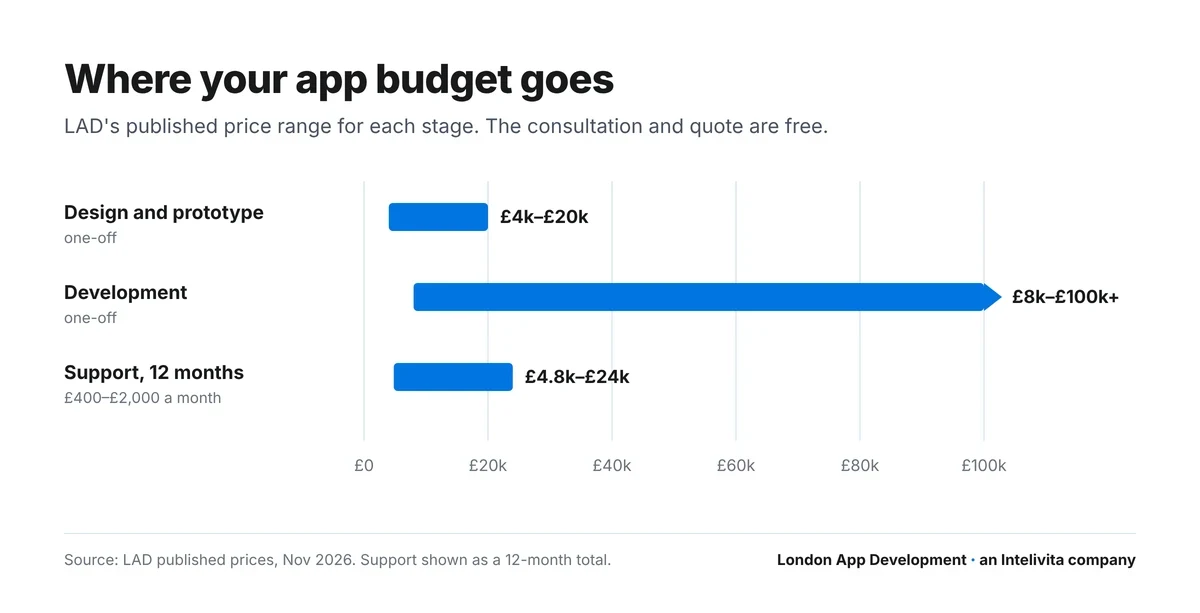
Building an app with LAD costs £4,000 to £20,000 for design and £8,000 to £100,000 or more for development. Support after launch is optional, at £400 to £2,000 a month. The consultation and quote are free.
| Stage or item | What you get | Price |
|---|---|---|
| Consultation and quote | Your scope written down, a fixed price and a timeline | Free |
| UX/UI design and prototype | User journeys, wireframes, Figma designs, a clickable prototype | £4,000–£20,000, one-off |
| Development | iOS, Android or web apps, back end, admin panel, integrations, testing | £8,000–£100,000+, paid at milestones |
| Support after launch | Bug fixes, security updates, new iOS and Android versions, new features | £400–£2,000 a month, optional |
| Build time | Simple app / moderate app / large app | 8–12 weeks / 3–6 months / 6–9+ months |
All other prices in this guide come from this list.
How much does an app cost in the UK by complexity?
A simple app costs about £12,000 to £30,000. A moderate app costs £30,000 to £70,000, and a complex app £70,000 to £120,000 or more. Complexity is set mainly by the number of user types and integrations.
| App complexity | What it usually includes | UK cost | Build time |
|---|---|---|---|
| Simple | One type of user, a few core screens, sign-in, basic data. Example: a booking app for one salon | £12,000–£30,000 | 8–12 weeks |
| Moderate | Two or more user types, payments or bookings, an admin panel, one or two integrations. Example: booking, staff rota and payments | £30,000–£70,000 | 3–6 months |
| Complex | Several connected apps, live tracking, many integrations, strict security. Example: customer, driver and admin apps | £70,000–£120,000+ | 6–9+ months |
Two apps with the same label can sit in different tiers. A booking app for one salon is simple. Add staff rotas, payments and a separate staff app, and it becomes moderate or complex. Each of those parts has to be designed, built and tested.
We see this in our own work. Talentbase, a chef staffing service, needed four products: a client app, a chef app, an admin panel and a website. That is four sets of design, build and testing on one back end (Talentbase case study).
You get an exact figure only once your scope is written down. The consultation and quote are free, and you get a fixed price for the agreed scope before work starts.
App development cost breakdown by stage
You pay for an app in four stages. The consultation and quote are free. Design costs £4,000 to £20,000, and development £8,000 to £100,000 or more. Support is optional, at £400 to £2,000 a month. Each stage gets a fixed price before it starts.
Why is design priced separately from development?
You approve every screen in Figma before any code is written. Changing a screen at design stage costs far less than changing it after it is built. A separate, fixed design stage protects your development budget.
Why does development cost the most?
Development covers everything that runs. That means the apps your users download, the back end that stores their data and the admin panel your team uses. It also covers every connection to payments, maps or your own systems. Each extra part adds build and testing time.
Is testing an extra cost?
No. Testing is part of development. Before each weekly demo, our team tests the app against the agreed requirements on real iPhones and Android phones.
How much does it cost to build for iOS, Android or both?
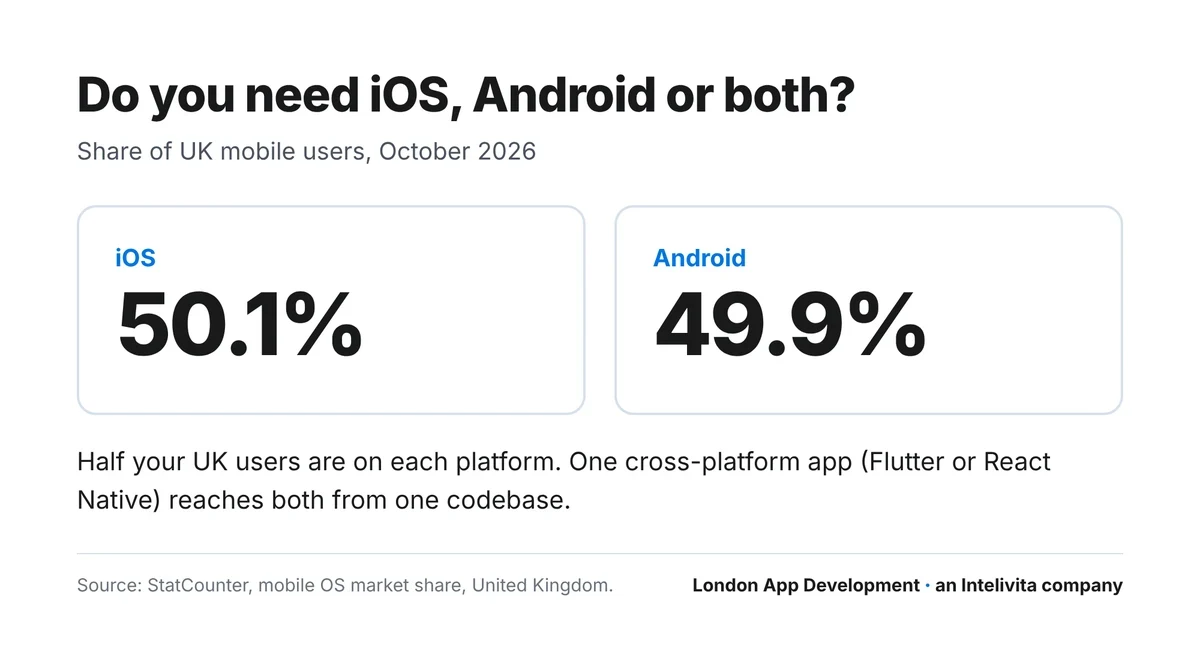
Building for both iOS and Android costs more than building for one. A single cross-platform app in Flutter or React Native usually costs less than two native apps, because most of the code is shared. Most UK businesses need both. In October 2026, iOS had 50.1% of UK mobile users and Android 49.9% (StatCounter).
| Approach | Codebases | Choose it when |
|---|---|---|
| iOS only (Swift) | 1 | Most of your users are on iPhone, or you want to launch on one platform first |
| Android only (Kotlin) | 1 | Most of your users are on Android, such as staff on company phones |
| Native iOS and native Android | 2 | Your app relies on the camera, Bluetooth, sensors or heavy graphics |
| Cross-platform (Flutter or React Native) | 1, shared | You want both platforms from one budget and one timeline |
iOS app development cost
An iOS app is built in Swift. To publish it on the App Store, you pay Apple US$99 a year for the Apple Developer Program (Apple). See iOS app development.
Android app development cost
An Android app is built in Kotlin. Google Play charges a one-time registration fee of US$25 (Google). Android runs on far more phone models than iOS, so testing covers more devices. Read more about Android app development.
Cross-platform app development cost
A cross-platform app is one codebase that runs on both iOS and Android. Pay N Park, a parking marketplace our team built, runs on both from a single Flutter codebase. Its ID checks and live face detection still needed testing on both platforms. Read more about cross-platform development.
App development cost by type of app
The type of app sets the starting features, so it gives you a fair first estimate. Costs run from about £10,000 for a simple utility app to £100,000 for a mobile game.
| Type of app | Typical UK cost | Typical timeline | What drives the cost | More detail |
|---|---|---|---|---|
| Utility (calculator, single tool) | £10,000–£35,000 | 2–5 months | One user type and one job | – |
| Ecommerce | £15,000–£60,000 | 3–6 months | Catalogue, checkout, payments, order tracking | Ecommerce app cost |
| Finance and money management | £15,000–£50,000 | 3–6 months | Bank or payment links, security, regulation | Finance app development |
| Education | £15,000–£50,000 | 3–6 months | Content, user roles, progress tracking | Education app cost |
| Service booking | £20,000–£70,000 | 4–8 months | Calendars, availability, reminders, payments | – |
| Productivity and collaboration | £20,000–£60,000 | 4–8 months | Shared data, permissions, sync | – |
| On-demand and delivery | £25,000–£80,000 | 4–9 months | Customer, driver and admin apps; live tracking | Food delivery apps, taxi apps |
| Health and wellness | £25,000–£80,000 | 4–9 months | Plans, tracking, chat with professionals, data privacy | Wellness app case study |
| Social networking | £30,000–£90,000 | 5–10 months | Profiles, feeds, messaging, moderation | Social media app cost |
| Mobile game | £40,000–£100,000 | 6–12 months | Graphics, game logic, performance on many devices | – |
| Real estate and property | Varies with scope | Varies with scope | Listings, search filters, viewing bookings, agent tools | Real estate app cost |
| IoT (apps that talk to devices) | Varies with scope | Varies with scope | Hardware connection, Bluetooth, device testing | IoT app cost |
Use the type only as a starting point. An ecommerce app selling one product line can cost less than a booking app with three user types.
Who should build your app: AI app builder, freelancer, agency or in-house team?
Who builds your app changes the price and what the price includes. An AI app builder is the cheapest way to test an idea. A freelancer charges less per day than an agency, but you manage design, testing and launch. An agency costs more per day but covers every stage and can give you a fixed price.
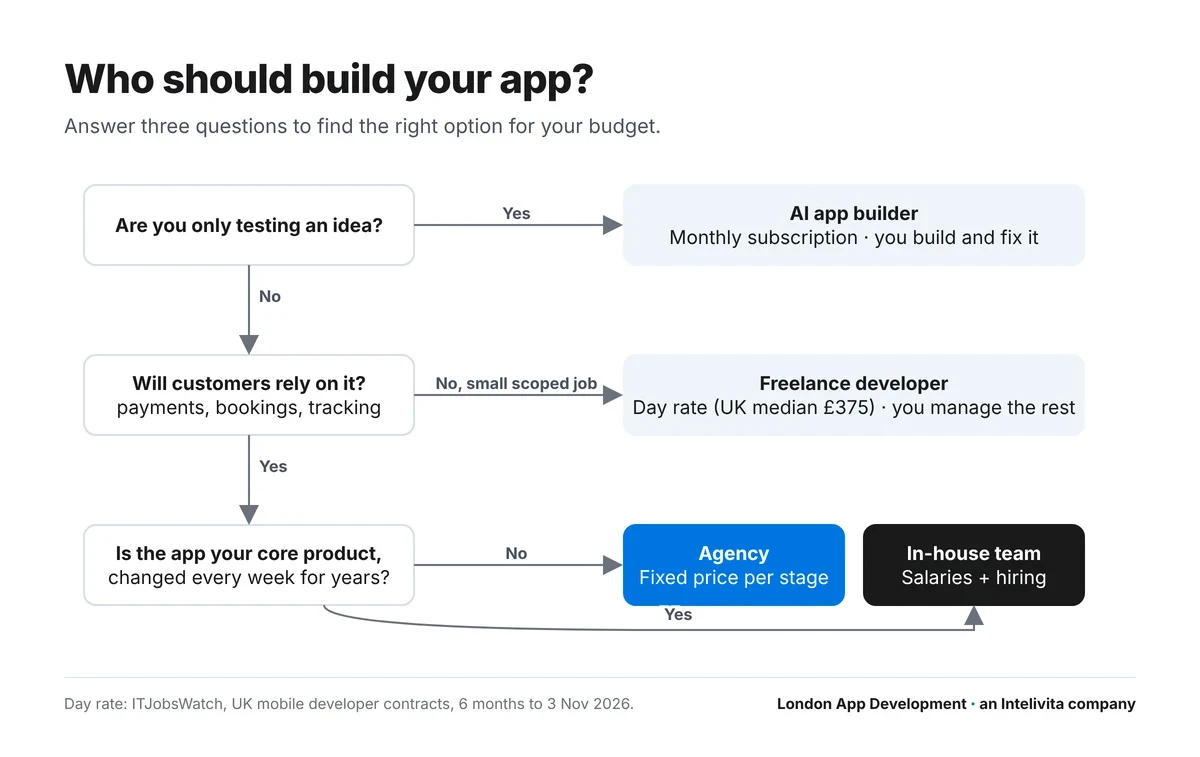
In short: testing an idea? Use an AI app builder. A small, tightly scoped job? A freelancer. An app customers will rely on? An agency. An app that is your core product and changes every week? An in-house team.
| Who builds it | How you pay | Best for | What you handle yourself |
|---|---|---|---|
| AI app builder, such as Base44 or Lovable | Monthly subscription | Testing an idea, a simple prototype or an internal tool | Building, testing and fixing it |
| Freelance developer | Day rate | A tightly scoped job, or extra help for your team | Design, testing, project management, publishing, support |
| App development agency | Fixed price per stage, or day rate | An app your customers rely on | Approving designs and reviewing each weekly demo |
| In-house team | Salaries plus recruitment | A business whose app is the product and changes every week | Hiring, managing and keeping the team |
How much do UK app developers charge per day?
The median day rate for UK mobile developer contracts was £375 in the six months to 3 November 2026. The middle half of rates sat between £370 and £395 (ITJobsWatch). The figure is based on 18 rates, so treat it as a guide.
At £375 a day, 60 working days from one developer costs £22,500. That covers coding only. Design, a back end, testing and project management come on top. This is why a freelancer quote and an agency quote for “the same app” rarely compare like for like.
When is an AI app builder enough?
An AI app builder is enough when you want to test an idea before you invest in it. It also suits you if the platform’s standard screens do the job and you are happy to fix the app yourself. Choose an agency when your app takes payments, bookings or live tracking. The same applies if it needs several connected apps or links to your own systems.
If you have already built a prototype with an AI builder, we will review it. We will tell you what it takes to turn it into an app you can launch.
If you are not yet sure people will use your idea, test it before you pay for a full build. An AI builder prototype is a cheap way to get real feedback in a few weeks. Once customers will rely on the app for payments, bookings or their data, that is the point to build it properly.
What real apps cost: budgets from 8 projects we have delivered
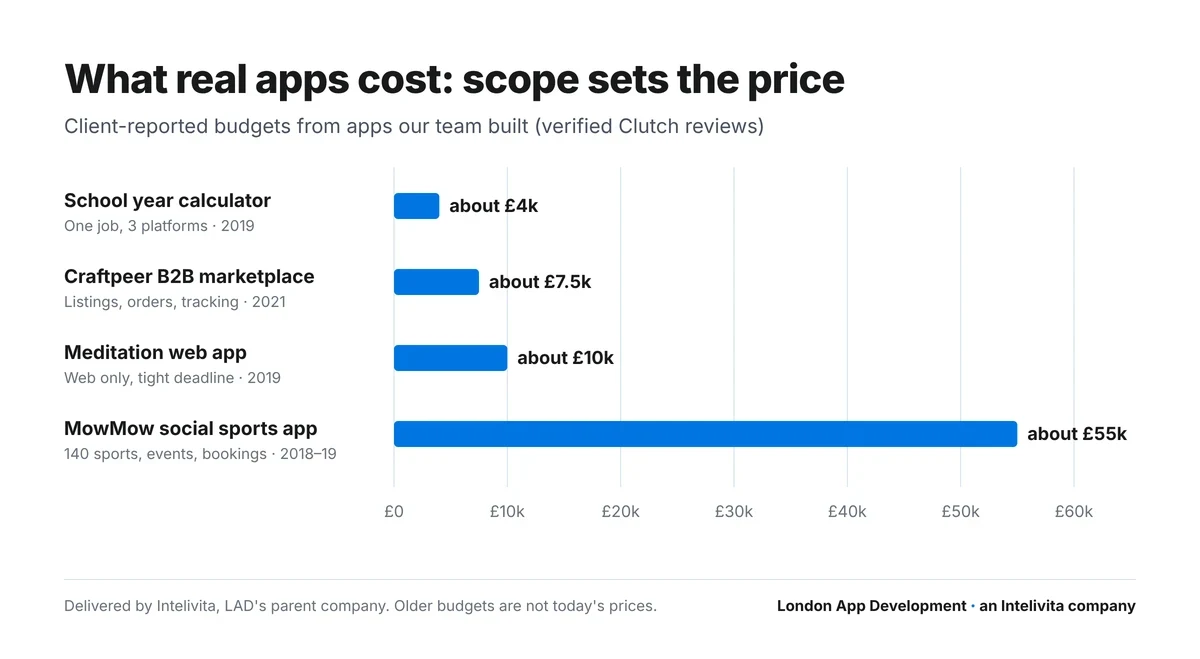
Our real app budgets range from about £4,000 for a single-feature app to US$50,000–US$199,999 for a website, app and admin system built over several years. Each client reported the budget in a verified review on Clutch. Our work appears there under Intelivita, our parent company.
| Project | What we built | Platforms | Dates | Budget (client-reported) |
|---|---|---|---|---|
| School year calculator, The Independent Education Consultants | One tool that turns a date of birth into a school year | iOS, Android, WordPress widget | Aug–Sep 2019 | About £4,000 |
| Craftpeer | B2B marketplace: listings, orders, delivery tracking, staff back end | iOS, Android | May–Oct 2021 | About £7,500 |
| Meditation web app, for a London agency | Web version of a meditation app | Web | Feb–Apr 2019 | About £10,000 |
| Wellness and fitness MVP, London | Workouts, nutrition plans, chat with a trainer and dietitian | iOS, Android | Jan–Oct 2022 | US$10,000–US$49,999 |
| Rewards platform | Mobile and web apps (Flutter, React, Next.js), with product input | Mobile, web | Nov 2024–ongoing | US$10,000–US$49,999 |
| Property maintenance and compliance platform | Mobile and web platform | iPhone, iPad, web | Nov 2025–May 2026 | US$10,000–US$49,999 |
| MowMow | Social sports app: profiles, events and bookings across 140 sports | iOS | Nov 2018–Dec 2019 | About £55,000 |
| Financial planning firm (UK) | A website, an app, a fact-finding site and an admin panel | App, web | Oct 2022–ongoing | US$50,000–US$199,999 |
Two more of our apps, Talentbase and Pay N Park, have case studies but no published budget.
What these numbers tell you
- Scope sets the price, not the number of platforms. The £4,000 app ran on three platforms but did one job. MowMow ran on one platform but covered 140 sports, events and bookings.
- A small first version is a real option. The wellness app launched as an MVP with only the features the client needed to go live.
- Ongoing products cost more over time because they keep growing. The financial planning project started in 2022 and is still being extended.
- Older budgets are not today’s prices. Ask for a current quote before you budget on a 2019–2022 figure.
What clients say about budget and delivery
Clients rate our work 4.8 out of 5 overall and 4.8 for cost across 52 Clutch reviews. The strengths they mention most are communication (19 reviews), project management (15) and timeliness (15).
What clients mention most
“Not only did they hit every milestone on time and within budget, but they have been an absolute pleasure to work with.”
“Intelivita has done all that we asked on time, and then adapted it all to suit our constant adjustments.”
“They combined strategic input with hands-on execution, helping shape the product while also building it.”
Source: Intelivita on Clutch, LAD’s parent company. Bars show the share of all 52 reviews. Checked 6 November 2026.
What affects the cost of building an app?
Seven factors decide most of an app’s cost. They are features, user types, design, back end, integrations, security and testing. Each one adds design, build and testing time, and that time is what you pay for.
| Cost factor | Why it raises the cost | Question to answer before you get a quote |
|---|---|---|
| Features | Every feature is designed, built, tested and maintained | Which features does version 1 need to launch? |
| User types | A customer app, a staff app and an admin panel are separate products on one back end | How many types of people use the app? |
| Design | Custom design for your brand takes longer than a template | Must the app match your brand from day one? |
| Back end and data | Accounts, data storage, admin tools and APIs sit behind every screen | What must the app store, and who manages it? |
| Integrations | Payments, maps, booking systems and your own software each need connecting and testing | Which systems must the app talk to? |
| Security and compliance | Personal data must be handled under UK GDPR; payment and health data need more care | What personal or payment data will the app hold? |
| Testing | Every feature is tested on real iPhones and Android phones | Which devices and OS versions do your users have? |
What factors influence the cost of building a mobile app?
Scope affects the cost of a mobile app most, meaning its features and user types. Platforms, design depth, integrations and data security come next. Adding a second type of user, such as drivers or staff, often means building a second app.
How do different app features affect the development cost?
Each feature adds its own design, build and testing time. Some also add running costs. A sign-in screen is quick to build. Live tracking, in-app payments and chat each need back-end work, a third-party service and extra testing. Many of those services charge per use.
Do the same factors affect how long an app takes to build?
Yes. The factors that raise an app’s cost also lengthen its timeline, because cost is mostly build time. A simple app takes 8 to 12 weeks. A moderate app takes 3 to 6 months. A large app with several parts takes 6 to 9 months or more.
Most clients count screens, but the cost sits behind them. Every extra type of user, every integration and every change after the build starts adds design, build and testing time. A second user type, such as drivers or staff, often means a second app.
How much does an app cost to run after launch?
An app’s running costs are support, app store accounts, hosting and pay-per-use services. A support plan costs £400 to £2,000 a month. Store fees are small. Hosting and third-party services grow with the number of people using your app.
| Running cost | What it covers | Cost |
|---|---|---|
| Support plan | Bug fixes, security updates, new iOS and Android versions, new features | £400–£2,000 a month |
| Apple Developer Program | Publishing on the App Store | US$99 a year (Apple) |
| Google Play developer account | Publishing on Google Play | US$25 once (Google) |
| Hosting and database | The servers that run your back end, for example on AWS | Grows with your number of users |
| Pay-per-use services | Payments (such as Stripe), maps (such as Google Maps), SMS and email | Charged per use by each provider |
Skipping support is a false saving. Apple and Google release new versions of iOS and Android every year. An app that isn’t updated slowly stops working as it should.
What does an app cost in its first year? A worked example
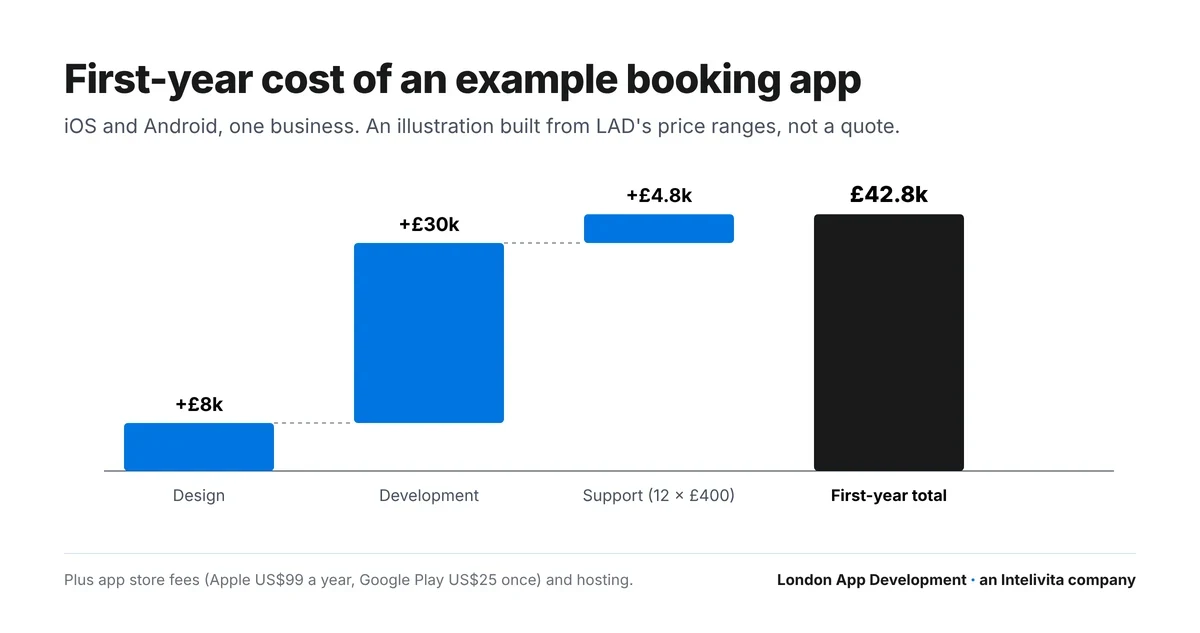
This example uses the price list above for a booking app for one business, on iOS and Android. It is an illustration, not a quote.
| Item | Example cost |
|---|---|
| UX/UI design and prototype | £8,000 |
| Development: both apps, back end and admin panel | £30,000 |
| Support plan, 12 months at £400 | £4,800 |
| Apple Developer Program, first year | US$99 |
| Google Play registration | US$25 |
| Hosting, 12 months | Depends on usage |
| First-year total | £42,800 + US$124 + hosting |
From the second year, you pay only the running costs, plus any new features you choose to add.
How do agencies price app development?
Agencies price app development in one of three ways: a fixed price, time and materials, or a dedicated team. A fixed price suits a first version with a clear feature list. Time and materials suits ongoing work whose priorities change.
| Pricing model | How it works | Good for | Watch out for |
|---|---|---|---|
| Fixed price | One agreed price for an agreed scope, paid at milestones | A first version or MVP with a clear feature list | Changes outside the scope are quoted separately |
| Time and materials | You pay a day or hourly rate for the time spent | Ongoing work with changing priorities | The total isn’t known in advance |
| Dedicated team | A set team for a monthly fee | A long-running product that needs steady work | You pay for the team even when work is quiet |
How LAD prices a project. You get a written quote with a fixed price and timeline for each stage before work starts. You pay a small amount upfront, then the rest at agreed milestones. You review the work before each payment. You own the source code and designs, and we will sign an NDA before your first call.
How do you brief an agency for an accurate quote?
An accurate quote needs an accurate brief. Send these six things, and two agencies will price the same app:
- The problem your app solves, and who it is for.
- Every type of user, such as customers, staff and admins, and what each one does.
- The features version 1 needs, listed separately from ideas for later.
- Your platforms: iOS, Android, web, or all three.
- The systems it must connect to, such as payments, booking software, your CRM or your website.
- Your deadline and budget range, so the agency can tell you what fits.
How do you compare app development quotes?
Compare quotes by what they include, not only by the total. Check that each one covers design, the back end, an admin panel and testing on real devices. It should also cover submission to both app stores and support after launch. A low quote that leaves out two of these isn’t cheaper. It is incomplete.
App quote checklist
1. Put in your brief
2. Check each quote includes
How to estimate your app’s cost in 5 steps
Estimate your app’s cost in five steps. The result tells you which band in this guide you fall into.
- Count your types of user. One type points to a simple app. A customer app, a staff app and an admin panel point to a moderate or complex app.
- List the features version 1 needs to launch. Put everything else on a “later” list.
- Choose your platforms. If you need iOS and Android, compare one cross-platform app with two native apps.
- List every integration. Payments, maps, booking tools, your CRM, any hardware.
- Add 12 months of running costs. Support (£400 to £2,000 a month), store fees and hosting.
For a figure for your own app, use our project estimator. Choose your app type and features, and we will arrange a discovery call within 48 working hours.
How can you reduce app development cost without cutting quality?
The safest way to reduce app development cost is to build less in version 1, not to pay less for the same scope. These five steps lower the cost without leaving you with an app you will have to rebuild:
- Launch an MVP first. Build the core features, launch, then add what your users ask for. Our wellness client did this. See MVP development and how to build an MVP.
- Use one cross-platform codebase if your app doesn’t depend on phone hardware such as Bluetooth or sensors.
- Approve every design before coding starts. Design changes cost far less than changes to finished screens.
- Use proven services for payments, maps and messaging instead of building your own.
- Test demand cheaply first with an AI app builder prototype before you commission the full build.
If budget is what’s holding you back, read how to get funding for your app in the UK.
I ask one question about every feature: does the app work on launch day without it? Extra dashboards, complex settings and nice-to-have screens usually go on the later list. A simpler first version is quicker to build, easier for users to learn and gets you real feedback sooner.
App development cost: frequently asked questions
What is the average cost of app development in the UK?
A custom app built by a UK agency costs about £12,000 to £120,000 or more. Design costs £4,000 to £20,000 and development £8,000 to £100,000 or more. Your app’s figure depends on its features, user types, platforms and integrations.
Is app development in the UK expensive?
App development is a significant investment, but you control most of the cost through scope. A first version with one type of user and the core features costs far less than a full product with several apps. You can add features after launch.
How much does a simple app cost?
A simple app with one type of user and a few core screens costs about £12,000 to £30,000. It takes 8 to 12 weeks to build. The smallest app in our case studies, a school year calculator for iOS, Android and the web, cost about £4,000 in 2019.
Can I build my own app for free?
You can build a basic prototype yourself with an AI app builder or a no-code tool. Most need a paid plan after a free tier. To publish the app, you still pay Apple US$99 a year and Google US$25 once. You also maintain the app yourself.
How much does it cost to make a game app?
A mobile game app costs about £40,000 to £100,000 and takes 6 to 12 months. Graphics, game logic and performance testing on many devices take longer than for a standard app.
How much does it cost to launch an app on the app stores?
Publishing costs US$99 a year for the Apple Developer Program. A Google Play account costs a one-time US$25. Most agencies include submission to both stores in the build. Marketing the launch is a separate budget.
How much does it cost to run an app per month?
A support plan costs £400 to £2,000 a month. It covers bug fixes, security updates and updates for new iOS and Android versions. Hosting and pay-per-use services, such as payments, maps and SMS, are extra and grow with your number of users.
How long does it take to build an app?
Most apps take 8 weeks to 9 months from design to launch. A simple app takes 8 to 12 weeks. A moderate app takes 3 to 6 months. A large app with several parts takes 6 to 9 months or more.
Do I have to pay for my app upfront?
Not with a milestone-based agency. You pay a small amount upfront, then the rest at agreed milestones. You review the work before each payment.
Do UK app development prices include VAT?
Always check whether a quote includes VAT before you compare agencies.
Get a fixed price for your app
Tell us what your app needs to do. You will get a written, fixed-price quote for each stage before any work starts. The consultation is free, and Dhaval is your contact from the first call to launch.
London App Development, an Intelivita company, is an app development company in London that designs, builds, launches and supports iOS, Android and web apps for UK businesses.