


Outsource your mobile app development when you need skills faster than hiring allows. Build in-house when the app is the product your business sells.
Mobile app development outsourcing means paying an outside team to design, build, test and release your app. This guide sets out what you gain and what goes wrong. The guide prices the in-house option, compares the four outsourcing models, and shows how to check an app development company. The last sections cover the work that stays with you.
We are London App Development. We take outsourced app projects, so you are reading the supplier’s side of the table.
What is app development outsourcing?
App development outsourcing means paying an external team to design, build, test and release your app. You outsource mobile app development to a third-party provider rather than hire that team yourself. You hand over the whole build, or only the parts your in-house team does not cover.
Three kinds of supplier take this work:
- A freelancer. Takes one role, such as an Android developer.
- An agency. Takes full-cycle development, from design through QA to release.
- A dedicated team. Sits inside your process and takes direction from you.
The projects in our case studies were delivered through Intelivita, our sister company. That work ran before London App Development Limited was registered in 2026. Our team is the outsourcing partner here, not an observer of one.
LAD is an Intelivita company. Across 52 verified Clutch reviews of our work, clients rate us 4.8 out of 5. Their project budgets range from US$2,000 to US$500,000 (Clutch, checked 14 November 2026).
What do you gain by outsourcing app development?
Outsource mobile app development and you get an app built without hiring. You buy a team that already exists, start in weeks instead of months, and pay only while the work runs. The reliable gain is speed and skills, not a lower total cost.
A team that already exists
An agency brings a ready-to-work team of designers, developers and QA testers who have worked together. You skip a recruitment round for every role. You get access to a global talent pool, not one city’s. Talentbase is a chef staffing business in London. Our team built its client app, chef app, admin panel and website.
Skills that are hard to hire
Outsourcing buys specialist skills for the weeks you need them. Cross-platform development in React Native or Flutter is the clearest case. One codebase reaches both app stores, and few UK firms employ that skill full time. Intelivita’s Clutch profile shows where that work sits. Mobile apps take 65%, AR and VR 25%, web 10% (Clutch, checked 14 November 2026). Hire that skill permanently and you pay for it long after the phase ends.
A start date you hold
An agency starts on the date in the contract. A new employee starts when their notice period ends, and that date sits outside your control. Faster time to market follows from the start date, not from faster coding.
Capacity you turn down
Scalability and flexibility work both ways. You size a dedicated development team to the phase, because research, design and build need different people in different weeks. The dedicated team shrinks when the phase ends. The University of Edinburgh’s research app has run with our team since January 2026 (Clutch, review dated 16 March 2026).
Delivery risk you share
A contract moves part of the delivery risk to the supplier. Milestones tie payment to code you have run yourself. Fixed scope ties the price to an agreed list of features.
Your core business keeps its people
Outsourcing lets you focus on core business while the build runs. Your staff keep selling and serving customers while a separate team ships the app.
Cost is the gain buyers name first. The evidence behind it is weaker than the evidence behind speed.
Is outsourcing cheaper than hiring app developers in the UK?
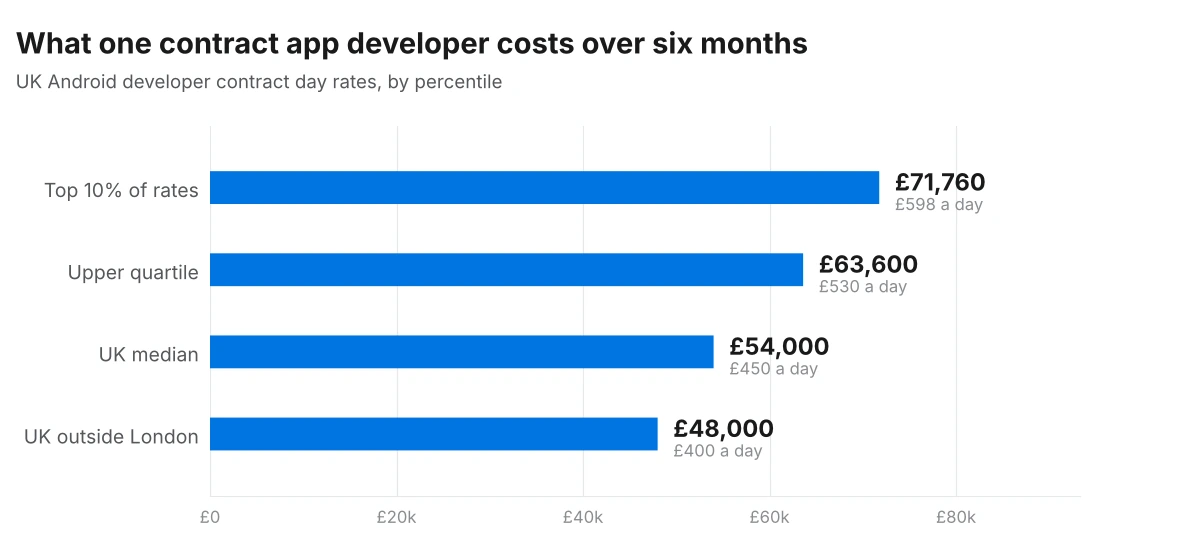
Outsourcing costs less than hiring for a single build with an end date. Outsourcing costs more than hiring for a product you change every month for years. One contract Android developer in the UK costs £54,000 over six months at the median day rate.
The median daily rate for an Android developer contractor in the UK is £450. Outside London, the median daily rate across the United Kingdom is £400 (ITJobsWatch, 6 months to 13 November 2026). At 20 working days a month, six months of one developer costs £54,000, or £48,000 outside London. That figure covers one person. A build also needs design, QA and project management.
A contractor rate is not the total cost of ownership of an in-house development team. A salary carries employer National Insurance, pension, equipment and holiday. Recruitment and onboarding come first. The recruitment cost lands before anyone writes a line of code. That fixed overhead stays whether the work is there or not. An agency replaces it with a project-based fee, a fixed price, or time and materials.
Cost saving is the claim most outsourcing pages lead with. The evidence is thinner than those pages suggest. The Deloitte Global Outsourcing Survey 2024 asked more than 500 business and technology leaders. Only 25% of their organisations saw a drop in the cost of vendor services. Fewer than half reported productivity gains.
So treat cost as the second reason to outsource, not the first.
Outsourcing pays when the work has an end. You pay for six months of a team, then you stop. Hiring the same team means paying salaries after launch. The work then drops to upkeep and small releases.
Outsourcing also pays when a product keeps moving without an internal team. Lifetime Digital Planning is a UK financial planning firm. Since November 2022 our team has built them a customer app, a coach portal and an admin panel. Spend sits between US$50,000 and US$199,999 (Clutch, review dated 11 March 2026).
The dividing line is the shape of the work, not the price. One build with an end date: outsource it. A product you change every week for three years: build the team.
What goes wrong when you outsource app development?
Outsourced builds fail on contracts and communication, not on code. Five failures cause most of the damage. They are unwritten scope, early payment, code you do not own, silence across time zones, and hidden quality problems.
| What goes wrong | The control that stops it |
|---|---|
| Scope that was never written down | A paid discovery phase, signed off before the build contract starts |
| Payment released ahead of delivery | Milestones tied to tested code you have run yourself |
| Code and store accounts you do not own | IP assigned on payment, and your own Apple Developer and Google Play Console accounts |
| Silence across time zones | A named contact, a fixed weekly demo and a shared backlog |
| Quality you cannot see until handover | Access to the source code repository from week one |
Two of those five deserve more than a row in a table.
Code ownership comes first, and the question is blunt: who owns the code when the last invoice is paid? Your contract must assign the intellectual property to you. The IP assignment takes effect on payment, not on completion. An NDA protects what you share before that contract exists. The App Store Connect and Google Play Console accounts must sit in your company’s name, not your supplier’s. An app you have no right to republish is an app you do not own.
Vendor lock-in is the quiet failure. One supplier holds the repository, the store accounts and the only person who knows the build. The contract will not save you. Milestone payments tied to tested code stop that happening.
Communication breakdown comes second, and here is London App Development’s own record on it. Intelivita’s Clutch profile carries a review highlight headed “Challenges with Communication and Delays”. The highlight notes that some clients met communication issues and delays. Communication is also the strength clients name most.
We publish the weaker scores alongside the strong ones. Jordan Doust is Data Manager at the University of Edinburgh. He rated a mobile research app 4.0 overall and 3.0 on cost (Clutch, review dated 16 March 2026). Ask every agency on your shortlist for its lowest-scoring review, then read that one first.
Three more controls matter in the UK. A paid discovery phase stops scope creep, because it fixes the brief before the build contract starts. UK GDPR decides where your users’ data sits, so agree data residency before any code is written. And price the upkeep in the same contract, because hidden costs surface after launch.
Contract terms decide all of this, not goodwill. Two red flags show up early. A supplier who agrees to everything has not read your brief. A quote far below the UK market gets paid later, in rework.
What are the app development outsourcing models?
There are four app development outsourcing models: onshore outsourcing, nearshore outsourcing, offshore outsourcing and team augmentation. The four models differ on day rate, on shared working hours, and on who runs delivery.
| Model | Where the team sits | Overlap with UK hours | Who runs delivery | What it suits |
|---|---|---|---|---|
| Onshore | United Kingdom | Full working day | The agency | Regulated work and on-site workshops |
| Nearshore | Europe | Most of the working day | The agency | Lower rates with same-day answers |
| Offshore | Outside Europe | Part of the morning | The agency | Defined scope and the lowest rates |
| Team augmentation | Anywhere | Set by contract | You | Adding people to a team you already run |
Most UK agencies sell blended delivery, not one model. They build a blended team for your project. A team in the United Kingdom runs discovery, design and delivery, and part of the engineering sits elsewhere. Full-cycle delivery stays with one supplier, which is the point of it. The blend is not the problem. A blend nobody describes to you is the problem.
Staff augmentation and team augmentation are one setup under two names. You add people to a team you already run. A dedicated development team is the opposite. The supplier runs it, and the dedicated team stays on your product month to month.
The pricing model is a separate choice. A fixed price suits a scope that will not move. Time and materials suits a scope that will. A monthly retainer suits a product with no end date.
So ask two questions before you agree an engagement model. Which named people sit in which country? Which hours of your working day do they share?
Should you outsource your app development?
Outsource when the app is a project with an end date. Outsource when you have no technical lead to spare, and the deadline is shorter than a hiring round. Build in-house when the app is the product your business sells.
When to outsource comes down to three things: the shape of the work, the skills you hold, and the clock. Outsource to validate an idea. An MVP buys that validation before you commit to a product roadmap and a payroll. Market timing is the other case. If your window closes before a hiring round ends, outsourcing is the only route that meets it.
The clearest case for outsourcing is a job with one defined output. The Independent Education Consultants in Oxford needed one thing. It is a calculator that tells a parent which school year their child is in. We built it as an app and as a website widget. That job has an end, so hiring for it makes no sense.
When not to outsource is the clearest case of all: an app that is your core product. If customers buy through the app, the knowledge belongs inside your core business. Long-term ownership then matters more than speed.
A hybrid model suits the teams in between. In that hybrid approach you keep the product roadmap, the architecture and a technical lead or CTO. You outsource the build.
One rule holds whichever route you take. If nobody on your side is able to judge a build, appoint someone who is before you brief anyone.
How do you check an app development company before you hire it?
Check an app development company on four things. Look at apps it has shipped that you download today. Read reviews on a directory it does not control. Confirm who owns the code and the store accounts, and which named person runs your project.
Do the due diligence in that order. Open the portfolio and download two shipped apps the company names. Read the verified reviews on an independent directory it does not control, such as Clutch. Ask for a reference call with a client whose project looked like yours. Then read the case study for that project and check the two accounts match.
Two questions to ask sort agencies from resellers. Who writes the code, your own employees or a subcontractor? And whose name is on the Apple Developer Program account at launch? Two red flags: a company that will not answer either question, and a portfolio you cannot download.
Here are our answers to that checklist. Our case studies name the clients rather than hiding them: Talentbase, Unify London Taxis, Ostique, Pay N Park and MowMow among them. Clients rate us 4.8 for cost (Clutch, checked 14 November 2026).
Clients chosen so none repeats a named client used in the prose:
Lifetime Digital Planning is in section 3, the University of Edinburgh in sections 2 and 4. –>
London App Development is an app development company in London. Dhaval calls you himself within one working day of your enquiry.
What does the client have to do?
Outsourcing is not hands-off. You decide what the app does. You test each build, supply brand and content, and sign off every milestone. You answer questions within a day or two.
Name a product owner on your side before the build starts. Client responsibilities sit with that person: acceptance testing on each release, the backlog in order, and sign-off on every milestone. They join the weekly demo, also called the sprint demo, and they agree the decision turnaround up front.
Supply the brand assets and the content early. Expect several hours a week while a build runs. The product owner needs the power to decide without calling a meeting.
How much does it cost to outsource app development?
Outsourcing an app in the UK starts near the cost of the team it replaces. Intelivita’s Clutch profile puts the hourly rate at US$25 to US$49 (Clutch, checked 14 November 2026). The final figure moves on scope, on the number of platforms, and on how much work you keep in-house.
Our full breakdown of UK prices, with real project budgets, sits in our guide to app development cost.
What to settle before you brief an app development company
Four things are worth deciding before you contact anyone.
Know how the build is funded. Grants, revenue and investment each change what you commit to, and when. Our guide to funding for app development covers the routes open to UK businesses.
Decide whether you want a first version or a finished product. A first version tests whether anyone wants the app. Our MVP development page explains what it includes.
Know the stages and how long they take. A build runs through discovery, design, coding, testing and release. Our guide to the app development process sets out each stage with a timeline planner.
Decide whether an agency is the right route at all. No-code tools, freelancers and in-house teams each suit different projects. Our guide on how to make an app has a chooser that matches your project to a build path.
Frequently asked questions
What is app development outsourcing?
App development outsourcing means hiring an external team to design, build, test or maintain a mobile app. The work goes to an agency, a dedicated team or a freelancer. You outsource a whole build or a single phase of one.
How much does it cost to outsource app development in the UK?
Cost moves on scope, platforms and the supplier’s location. A simple app sits at the bottom of the range, and a regulated platform sits at the top. Ask for an itemised quote that splits discovery, design, build, testing and upkeep.
Is it cheaper to outsource an app than to hire developers?
Outsourcing costs less for one build with an end date, because you stop paying when the work stops. Hiring costs less over several years, because a salary carries no agency margin. The crossover arrives when the app needs constant change rather than occasional releases.
Who owns the code and the App Store account when you outsource?
Ownership follows the contract, not the work. A contract that assigns intellectual property on payment gives the client the code, the designs and the repository. The Apple Developer and Google Play Console accounts belong in the client’s company name, so the app stays publishable if the deal ends.
What should an app development outsourcing contract include?
A contract needs a defined scope, a milestone schedule tied to tested code, and an IP assignment that takes effect on payment. It also needs an NDA, named contacts on both sides, and terms for handover and exit. Upkeep after launch is priced on its own.
How do you pay an outsourced app development team?
Payment runs on fixed price, on time and materials, or on a monthly retainer for a dedicated team. Fixed price suits a scope nobody expects to change. Tie each payment to a milestone you have tested, rather than to a date in the calendar.
What are the downsides of outsourcing app development?
Three drawbacks matter: less sight of the work, delays when hours do not overlap, and a supplier who holds knowledge you do not. Contracts and weekly reporting reduce all three. The risk no contract fixes is a client who stops paying attention.
When should you not outsource app development?
Avoid outsourcing when the app is the product the business sells. Avoid it when you cannot yet say what the app must do, because an unclear project turns into paid scope discovery. Avoid it when nobody internally is able to judge a build.
Can you outsource only part of an app build?
Yes. Design, QA, a single platform or post-launch maintenance each go out on their own. Partial outsourcing suits teams that hold some skills in-house, and it keeps product knowledge inside the business.
Get a straight answer on whether to outsource
An outsourced build suits some apps and not others. LAD scopes your app on a free call, fixes the price, and splits the build into milestone payments.
Bring your idea, your deadline and your budget. We’ll tell you whether outsourcing it is the right call.
Sources and method. Figures come from three sources. ITJobsWatch, for UK Android Developer contract rates, 6 months to 13 November 2026. Deloitte’s Global Outsourcing Survey 2024. Intelivita’s Clutch profile, checked on 14 November 2026. Client names, project dates and ratings come from verified Clutch reviews and from our own case studies.