


Ecommerce app development cost in the UK is £15,000 to £60,000 for a custom app built by an agency. A marketplace or delivery app with several types of user costs £25,000 to £80,000. Turning an online store you already have into an app costs less, because the app reuses your website.
Five things set the price: the route you choose, your features, how customers pay, how many types of user you have and which platforms you need. This guide prices each one and shows what four real ecommerce apps built by our team cost.
LAD is an app development agency in London and an Intelivita company. Across 52 verified Clutch reviews of our work, clients rate us 4.8 out of 5 (Clutch, checked 8 November 2026).
Key takeaways
- Custom ecommerce app: £15,000 to £60,000, built in 3 to 6 months.
- Marketplace or delivery app: £25,000 to £80,000, because each extra user type needs its own app or dashboard.
- Store-to-app: the cheapest route. Our two apps built on existing websites cost US$3,200 and £7,000 (client-reported).
- What adds the most cost: payments, live tracking, a second app (such as a driver app) and links to your stock or order systems.
- After launch: budget for support, card fees (1.5% + 20p per standard UK card on Stripe) and hosting.
To price your own app, answer 3 quick questions in the ecommerce app cost calculator further down this page.
How much does ecommerce app development cost in the UK?
An ecommerce app costs £15,000 to £60,000 to build for one store, and up to £80,000 for a marketplace or delivery app. The biggest factor is the route you take. Bringing your existing store into an app costs the least; building a marketplace for many sellers costs the most.
| Route | What you get | UK cost | Build time | Best for |
|---|---|---|---|---|
| Store-to-app | An app connected to your Shopify or WooCommerce store, or built on your website | Quoted after a short call | 1–3 months | A store that already sells online and wants an app for repeat customers |
| Custom ecommerce app (one store) | Your own catalogue, search, cart, checkout, payments, order tracking and an admin panel | £15,000–£40,000 | 3–6 months | A B2C brand that wants its own app design and features |
| Advanced ecommerce app | A custom app plus a loyalty programme, personalisation and links to stock, ERP or CRM systems | £40,000–£60,000 | 4–6 months | Established retailers with several systems to connect |
| Marketplace or delivery app | Separate apps or dashboards for buyers, sellers or drivers, plus payouts and tracking | £25,000–£80,000 | 4–9 months | Multi-vendor marketplaces, B2B ordering and on-demand delivery |
The type of business you run changes which route fits:
- B2C store: a store-to-app or a custom ecommerce app fits best.
- B2B ordering: buyers place repeat orders through trade accounts. Craftpeer’s B2B marketplace launched without card payments in the app (see below).
- D2C or subscription brand: a custom app with accounts, reorders and push notifications.
- Marketplace or delivery: several user types, so the top band.
Every route is priced from the same stages that set app development cost in the UK: design at £4,000 to £20,000 and development at £8,000 to £100,000 or more.
What real ecommerce apps cost: 4 budgets from our projects
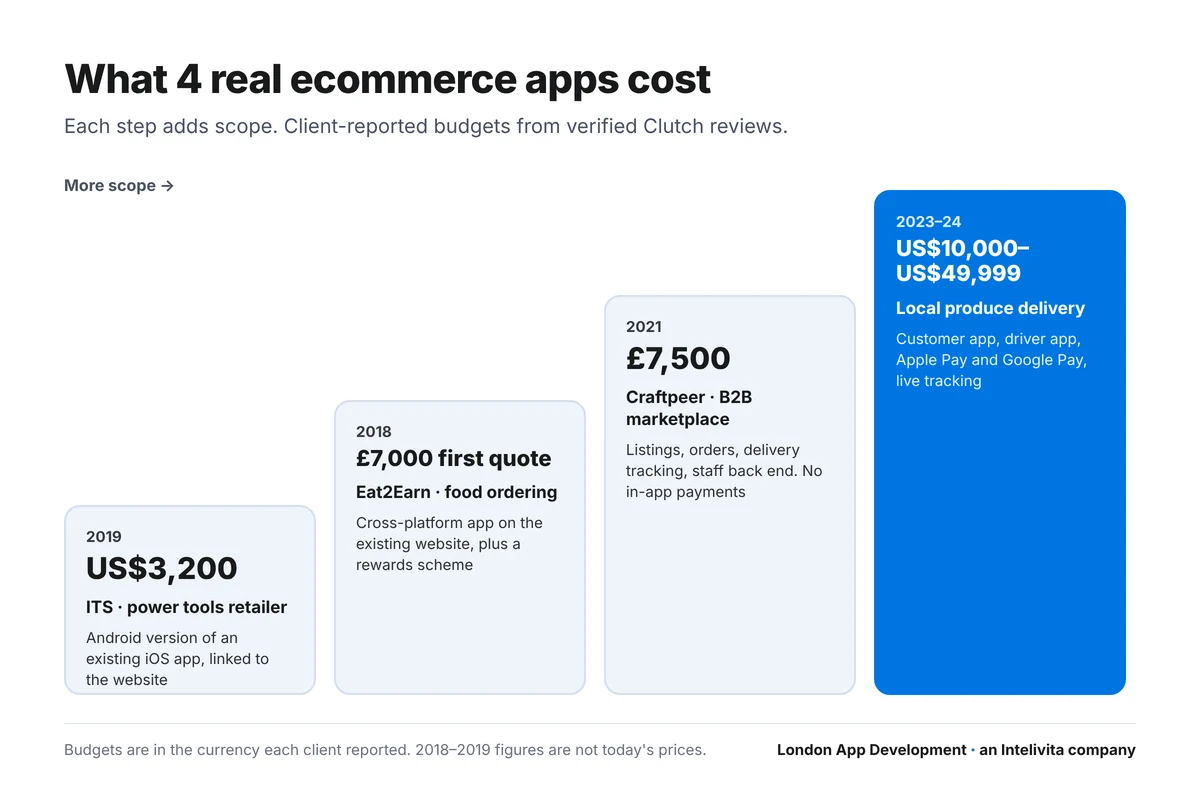
Our ecommerce apps have cost from US$3,200 to a US$10,000–US$49,999 budget. The cheapest reused a website the client already had. The most expensive needed two apps, payments and live tracking. Each client reported the budget in a verified review on Clutch, where our work appears under Intelivita, our parent company. Clutch records budgets in US dollars.
| Project | What we built | Platforms | Dates | Budget (client-reported) | What set the cost |
|---|---|---|---|---|---|
| ITS, a UK power tools retailer with a 20,000-tool catalogue | An Android version of its existing iOS app, linking to its website, with separate alerts for buying guides, videos, products and deal of the day | Android | Jan–Mar 2019 | US$3,200 | It reused the website and an app design that already existed. No cart or checkout of its own |
| Eat2Earn, an online food ordering platform | A cross-platform app showing the existing website, plus a five-level rewards scheme for customers and restaurants | iOS, Android | From May 2018 | First quote £7,000 | Built on top of the existing website; only the rewards scheme was new |
| Craftpeer B2B marketplace app | Seller product listings, order handling, delivery tracking, product concerns and a staff back end | iOS, Android | May–Oct 2021 | £7,500 | No in-app payments or chat. Journeys agreed as templates before coding |
| A UK local produce delivery service | A customer ordering app, a delivery driver app, Apple Pay and Google Pay, order tracking, driver tracking and a website promoting the app | iOS, Android, web | Jul 2023–Jul 2024 | US$10,000–US$49,999 | Two apps on one back end, card payments and live tracking |
What these budgets tell you
- Reusing what you have keeps the cost down. ITS and Eat2Earn built on websites they already ran. Their apps cost a fraction of a full build.
- Payments and a second app type raise the price most. The delivery service needed a customer app, a driver app, Apple Pay, Google Pay and live tracking. That put it in the top band of the four. It’s the main cost difference in delivery app development: the driver app is a second product, with its own screens, location tracking and testing.
- Leaving features out of version 1 is a real saving. Craftpeer launched a working marketplace without in-app payments or chat.
- Plan the journeys before coding. Craftpeer’s owner advised other buyers to “go the extra mile by designing your wireframes or templates”.
- Older budgets are not today’s prices. The 2018–2019 figures show the scale, not a current quote.
What these clients said
“Their team grasped our intentions with the app easily.”
“Intelivita proposed concrete solutions from the very beginning.”
“They’re always responsive and a great company to work with.”
Two honest notes from these reviews: Craftpeer’s project ran longer than its original proposal, and ITS’s own developer built the link to its back office.
Is it cheaper to turn your online store into an app or build a custom one?
Turn your online store into an app if your website already sells well and you mainly want an app for repeat customers. Choose custom app development if you need features your store can’t offer, or you’re starting from scratch. An app builder subscription is the third option: quick to launch, but you rent it every month.
| Option | Upfront cost | Ongoing cost | What you control | Best for |
|---|---|---|---|---|
| App builder subscription | Low; set up on the builder’s ready-made templates | Monthly fee: from under US$100 to several thousand dollars a month (MobiLoud) | Limited to the builder’s features; you stop paying, the app stops | A small Shopify store testing whether customers want an app |
| Store-to-app build | Quoted after a short call | Support plan, from £400 a month | Your own app, using your store’s products, prices and checkout | A store with steady sales and loyal customers |
| Custom ecommerce app | £15,000–£60,000 | Support plan, £400–£2,000 a month | Everything: design, features, data and code you own | A brand that needs its own journeys, loyalty or integrations |
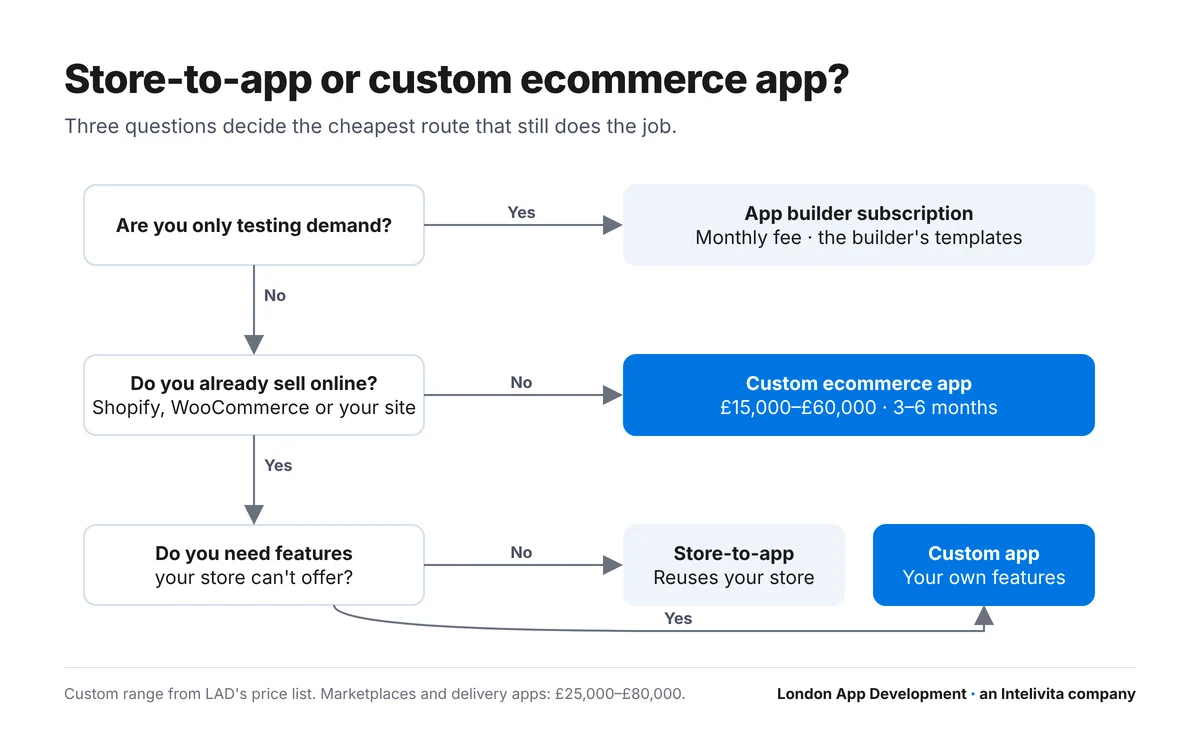
In short: already selling, and happy with your store’s features? Bring your store into an app. Need features your store can’t offer? Build custom. Only testing demand? Try a builder first.
Our two cheapest ecommerce apps took the store-to-app route. ITS kept its website as the source of products and content, and Eat2Earn’s app showed its existing site using basic APIs. Shopify and WooCommerce both offer APIs that let an app read products and create orders, so your store stays the single place you manage stock and prices.
If your website already sells, start by bringing that store into an app. Add custom features once you see what your app customers actually use.
Which ecommerce app features cost the most?
Payments, live tracking, a second type of app and third-party integrations with your business systems add the most cost. A product catalogue, search and a cart are standard, so they add the least. Each feature needs design, build and testing time, and payments, maps and AI search add monthly fees.
| Feature | What it involves | Effect on cost | Example from our work |
|---|---|---|---|
| Product catalogue and search | Product pages, filters and search | Low | Craftpeer’s seller listings |
| Cart and checkout | Basket, delivery options, order confirmation | Medium | – |
| Payments (Apple Pay, Google Pay, Stripe) | A payment gateway such as Stripe, saved cards, refunds, testing every payment path | Medium to high | The delivery service took Apple Pay and Google Pay |
| Order tracking | Order status updates from your back office | Medium | Craftpeer buyers track each delivery |
| Push notifications | Alerts for orders, offers and new content, sent through a service such as Firebase | Low to medium | ITS sends separate alerts for guides, videos, products and deals |
| Loyalty programme or rewards | Points, levels and rewards logic | Medium to high | Eat2Earn’s five-level rewards for customers and restaurants |
| Reviews and wishlists | Ratings, saved items | Low | – |
| Admin panel or staff back end | Manage products, orders, users and content | Medium | Craftpeer’s staff back end for buyer and seller accounts |
| Driver app and live tracking | A second app plus map and location services | High | The delivery service’s driver app |
| Stock, ERP or CRM links | Syncing products, stock levels and customers with your systems | High | ITS linked the app to its back office |
| AI search and product recommendations | A third-party search or recommendation service connected to your catalogue | Medium to high, plus monthly fees | – |
What UK rules does an ecommerce app have to follow?
A UK ecommerce app must protect customer data, keep card details secure and let customers cancel. Plan these from the start, because adding them later costs more.
- UK GDPR: you need a lawful reason to hold customer data, a clear privacy notice and a way to delete accounts (ICO).
- Card security (PCI DSS): let a provider such as Stripe handle card numbers, so your app never stores them.
- Cancellations and returns: UK customers have 14 days from receiving goods to cancel an online order, with exceptions such as perishable or personalised items, under the Consumer Contracts Regulations 2013. Your app needs a clear way to request a return or refund.
- Apple’s payment rule: apps that sell physical goods must take payment by methods other than Apple’s in-app purchase, such as Apple Pay or card entry (Apple guideline 3.1.3(e)). So Apple takes no commission on your product sales.
What will your ecommerce app cost?
Answer 3 quick questions to see a price range for your app.
Question 1 of 3
What kind of app do you need?
Native, cross-platform or PWA: which ecommerce app costs less?
A progressive web app (PWA) costs the least, a cross-platform app comes next, and two native apps cost the most. A cross-platform app built in Flutter or React Native shares one codebase between iOS and Android. For an ecommerce mobile app sold through both app stores, it’s the best balance of cost and quality.
| Approach | Codebases | Effect on cost | Best for |
|---|---|---|---|
| PWA (progressive web app) | 1, runs in the browser | Lowest; no app store listing | Testing an app-like experience on your existing site |
| Cross-platform (Flutter or React Native) | 1, shared by iOS and Android | Lower than two native apps | Ecommerce apps that need both app stores |
| Native iOS (Swift) and Android (Kotlin) | 2 | Highest | Apps that rely on heavy graphics, AR or deep phone features |
| One native platform first | 1 | Lowest native option | Stores whose customers are on one platform |
Two of our projects show the difference. Eat2Earn chose cross-platform app development: one app for iOS and Android, built on its existing website. ITS started with an iOS app built by its own developer, then paid US$3,200 for Android app development of the same app. Launching on one platform and adding the second later spreads the cost.
How much does a marketplace app cost?
A marketplace app costs £25,000 to £80,000 in the UK. It costs more than a single-store app because buyers and sellers each need their own screens, and you need tools to manage both. Taking payments for sellers and paying them out raises the cost further.
What adds cost to a multi-vendor marketplace:
- Seller onboarding: seller accounts, product upload and approval.
- Split payments and payouts: taking one payment, keeping your commission and paying each seller.
- Two-sided reviews and messaging: buyers rate sellers, and both sides message each other.
- Admin and moderation: your team checks sellers, products and disputes.
Craftpeer shows a marketplace starting small. Its first version cost £7,500 in 2021. Sellers listed products, buyers ordered and tracked deliveries, and staff managed both sides. It had no in-app payments or chat; adding those would have raised the cost.
What does an ecommerce app cost to run?
An ecommerce app’s running costs are support, card fees, hosting and app store fees. A support plan, your main maintenance cost, costs £400 to £2,000 a month. Stripe charges 1.5% + 20p per payment on a standard UK card. Hosting grows with your number of customers and orders.
| Running cost | What it covers | Cost |
|---|---|---|
| Support plan | Bug fixes, security updates, new iOS and Android versions, new features | £400–£2,000 a month |
| Card payment fees | Each card payment through your provider | 1.5% + 20p per standard UK card on Stripe (Stripe) |
| Hosting and database | The servers behind your app, for example on AWS | Grows with your users |
| Apple Developer Program | Publishing on the App Store | US$99 a year (Apple) |
| Google Play developer account | Publishing on Google Play | US$25 once (Google) |
Hidden costs to budget for
The costs people forget are the ones that grow with success, or that arrive every year.
- Fees that grow with sales: card fees, SMS messages and map services all charge per use.
- New iOS and Android versions: Apple and Google update their systems every year, and your app needs testing and updates to keep working.
- Third-party services: search, reviews, analytics and recommendation tools charge monthly fees.
- Content and stock upkeep: someone has to keep products, prices and photos up to date, unless your app reads them from your store.
- Marketing your app: customers won’t find it in the stores without promotion.
What does an ecommerce app cost in its first year? An example
This example is for a custom app for one store, on iOS and Android, using LAD’s price list. It’s an illustration, not a quote.
| Item | Example cost |
|---|---|
| UI/UX design and prototype | £6,000 |
| Development: cross-platform app, back end, admin panel, payments | £24,000 |
| Support plan, 12 months at £400 | £4,800 |
| Apple Developer Program, first year | US$99 |
| Google Play registration | US$25 |
| Card fees and hosting | Grow with your sales |
| First-year total | £34,800 + US$124 + card fees and hosting |
How long does it take to build an ecommerce app?
It takes 3 to 6 months to develop an ecommerce app with custom features. A marketplace or delivery app takes 4 to 9 months. A store-to-app build is quicker. Our own projects ranged from 3 months for ITS’s Android app to 12 months for a delivery service with a driver app.
| Project | What was built | How long it took |
|---|---|---|
| ITS | Android version of an existing iOS app | 3 months (Jan–Mar 2019) |
| Craftpeer | B2B marketplace app with a staff back end | 6 months (May–Oct 2021) |
| Local produce delivery service | Customer app, driver app and website | 12 months (Jul 2023–Jul 2024) |
The client of the delivery app wanted everything finished within a year, and every milestone arrived on time. At each one, the team sent a test app for the client to try and request changes.
Is an ecommerce app worth it for your business?
An ecommerce app is worth it when you have customers who buy from you again and again. An app keeps your store on their phone and lets you reach them with push notifications. If your customers buy once and don’t return, put the same budget into your website instead.
To check, work out how many extra orders the app needs to pay back its first year:
Break-even example (illustration): a custom app costs £30,000 to build and £4,800 a year to support, so £34,800 in year one. If your average order value leaves £15 profit per order, the app pays for itself after 2,320 extra orders in its first year (£34,800 ÷ £15). Use your own profit per order and your own build quote.
An app pays off when:
- Your customers already make repeat purchases.
- You sell items people reorder, such as food, groceries, trade supplies or beauty products.
- You have a loyalty scheme, or you want one.
- You have offers or new products to tell customers about each week.
An ecommerce app earns its cost through repeat customers, not first-time visitors. If your sales are one-off, put the budget into your website first.
How to reduce your ecommerce app cost
The safest way to reduce your ecommerce app cost is to build less in version 1, and reuse what you already have. A lower price for the same scope means less testing or less support. These steps lower the cost without leaving you with an app you’ll have to rebuild:
- Start from your existing store. Let the app read products, prices and stock from Shopify, WooCommerce or your website.
- Launch on one platform, or go cross-platform. One codebase for iOS and Android costs less than two native apps.
- Agree the journeys before coding. Map how buyers, sellers and staff use the app as templates or wireframes first, as Craftpeer did.
- Use proven payment services. Stripe, Apple Pay and Google Pay cost less than building your own payment system.
- Launch in phases. Release the core shopping journey first through MVP development, then add loyalty, AI search or chat when customers ask for them.
- Compare quotes like for like. Use an app development quote checklist to check each one includes design, the admin panel, testing on real phones, store submission and support.
Ecommerce app development cost: FAQs
How much does it cost to build an e-commerce app?
A custom e-commerce app costs £15,000 to £60,000 to build in the UK. A marketplace or delivery app costs £25,000 to £80,000. Turning an existing online store into an app costs less, because the app reuses your products, prices and checkout.
Can I turn my Shopify or WooCommerce store into an app?
Yes. Both Shopify and WooCommerce have APIs that let an app read your products and create orders. Your two options are an app builder on a monthly subscription, or an app that a developer builds and connects to your store. Your store stays the one place you manage stock and prices.
How much does it cost to build an app like Amazon?
An app with Amazon’s full features costs far more than any range in this guide, because Amazon runs thousands of sellers, its own delivery network and personal recommendations. Start with a single-store app or a small marketplace, then add sellers, payments and recommendations as orders grow.
Do ecommerce apps have to use Apple’s in-app purchase?
No. Apple’s rules say apps that sell physical goods must take payment by other methods, such as Apple Pay or card entry. So Apple takes no commission on product sales made through your app. In-app purchase is for digital content used inside the app.
Is an app cheaper than an ecommerce website?
No. A business needs a website first, because that’s where new customers find you through search. An app costs extra on top and works best for customers who already buy from you regularly. If you already sell online, a store-to-app build is the cheapest way to add an app.
Do I need both an iOS and an Android app?
Yes, for a UK store. In October 2026, 50.1% of UK mobile users were on iPhone and 49.9% on Android (StatCounter). A cross-platform app built in Flutter or React Native covers both from one codebase, which costs less than two native apps.
How much does an ecommerce app cost to maintain each month?
A support plan costs £400 to £2,000 a month. It covers bug fixes, security updates and updates for new iOS and Android versions. Card fees (1.5% + 20p per standard UK card on Stripe), hosting and third-party services are extra and grow with your sales.
How long does it take to build an ecommerce app?
A custom ecommerce app takes 3 to 6 months. A marketplace or delivery app takes 4 to 9 months. A store-to-app build is quicker, because the products, prices and checkout already exist.
What features does an ecommerce app need?
At minimum, an ecommerce app needs a product catalogue with search, a cart, checkout with secure payments, order tracking and an admin panel. Push notifications and a loyalty programme help bring customers back. Live tracking, a driver app and links to stock systems are needed only by delivery services, marketplaces and stores with several back-office systems.
Get a fixed price for your ecommerce app
Tell us about your store and what your app needs to do. You’ll get a written, fixed-price quote for each stage before any work starts. The consultation is free, and Dhaval is your contact from the first call to launch.
London App Development, an Intelivita company, designs, builds and supports ecommerce, marketplace and delivery apps for UK businesses.