


Funding for app development in the UK comes from 4 main places: savings, early customers, a Start Up Loan and angel investors using SEIS. Investors fund proof, so a first app starts with the founder and people who know them. Investors, grants and crowdfunding come once people clearly want the app. The sections follow that order, from idea to investment.
You’ll find how to get funding for an app idea, step by step. It covers how much funding you need, the types of funding available for a mobile app, and what UK investors check. It’s written for founders and small business owners planning app development for startups on a tight budget. Every scheme figure links to GOV.UK, HMRC or the British Business Bank.
Key takeaways
- Raise your build cost, plus 12 months of running costs, plus a 15% buffer.
- Investors fund proof, not ideas. A clickable prototype and user feedback come first.
- A £25,000 Start Up Loan at 6% costs £483 a month over 5 years.
- SEIS gives angel investors 50% income tax relief, so a £20,000 stake risks £10,000.
- Grants fund new technology. Innovate UK’s open Smart Grants have been paused since January 2025.
Do you need funding for your app yet?
You need outside funding for your app only when 3 things are true. You know the build cost, users have confirmed the problem, and your own money won’t cover the next step. Until then, outside money costs more than it gives.
Answer these 4 questions before you approach anyone:
- Do you know your build cost? A written scope and a fixed quote turn a guess into a number.
- Have target users confirmed the problem? Conversations, a waiting list or pre-orders count. Friends’ praise doesn’t.
- Can you fund the next step yourself? A prototype costs far less than a full app.
- Do you know what the money buys? Investors ask exactly how each pound gets spent.
If you answered “no” to any question, fix that first. It’s cheaper than giving away shares.
Outside money always has a price:
| Type of money | What it costs you |
|---|---|
| Loan | Monthly repayments, even if the app fails |
| Angel or VC investment | A share of your company and some control |
| Equity crowdfunding | Shares, platform fees and hundreds of small shareholders |
| Grant | Strict rules, reporting and match funding |
One founder on r/startups had 3 million downloads and still chose to grow from revenue. Commenters warned that investors expect an exit and founders give up shares. Raise funds when money blocks growth and you know what it buys.
How much funding do you need for your app?
The funding you need for your app is its build cost, plus 12 months of support, plus a 15% buffer. For a simple UK app, that comes to £35,190, not the £21,000 build price alone.
These are London App Development’s fixed-price bands, checked November 2026:
| What you pay for | What it covers | LAD price | Time |
|---|---|---|---|
| Design and clickable prototype | Wireframes and designs users tap through | £4,000–£20,000 | Before the build |
| Simple app | One user type, core screens, sign-in | £12,000–£30,000 | 8–12 weeks |
| Moderate app | Several user types, payments, admin panel | £30,000–£70,000 | 3–6 months |
| Complex app | Connected apps, live tracking, many integrations | £70,000–£120,000+ | 6–9+ months |
| Support after launch | Fixes, security updates, new OS versions | £400–£2,000 a month | Ongoing |
How much should you raise for your app?
Answer 3 quick questions to see your funding range and your next step.
Question 1 of 3
What do you want to build first?
Here’s the raise for a simple app at the middle of each band. The build is £21,000. Twelve months of support at £800 adds £9,600. A 15% buffer adds £4,590. The total is £35,190.
Add the app store accounts on top: US$99 a year for Apple and US$25 once for Google Play. Add your launch marketing too.
Three choices push the number up:
- Both platforms at once. A cross-platform build covers iPhone and Android from one codebase. Two native apps cost more.
- A fixed launch date. A tight deadline needs more developers working at once.
- Updates after launch. An app is never finished. Apple and Google release new OS versions every year.
Features and integrations move your app development cost within each band. The full breakdown by app type sits in our guide to how much an app costs in the UK.
Can you get funding with just an app idea?
Rarely. Investors fund proof that people want your app, not the idea itself. Founders on r/StartUpIndia and Quora with working prototypes still struggled to get investor replies.
Each step of proof costs more and opens a bigger funding route:
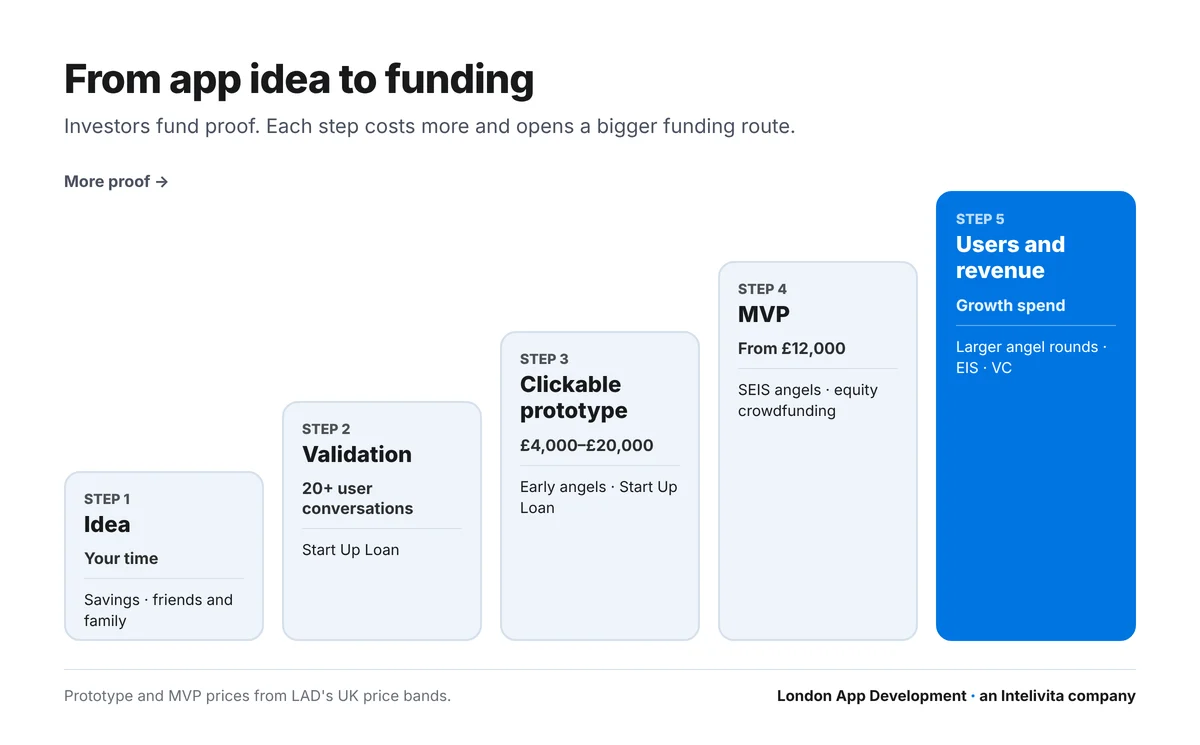
Text version: idea (savings) → validation (Start Up Loan) → clickable prototype (early angels) → MVP (SEIS angels, crowdfunding) → users and revenue (larger rounds, EIS, VC).
How do you validate an app idea before you spend money?
You validate an app idea by talking to 20 to 50 target users before you build anything. Ask what problem they face, how they solve it today, and what they’d pay.
- Collect a waiting list. A simple landing page with an email sign-up measures real interest.
- Find design partners. For a business app, ask 2 or 3 companies to test it early.
- Sell a paid pilot. A business that pays upfront funds part of your build.
- Record the calls. One founder on r/StartUpIndia shared user call recordings with investors as proof.
Aim for 20 to 25 people who want your app badly. That evidence opens doors that an idea alone never will.
The first version of an app exists to learn what customers actually want. Spend your first money on that learning, not on every feature you’ve imagined. It’s the proof investors look for, and it stops you building the wrong app.
Why does your own money matter to investors?
Your own money shows investors you believe in the app enough to risk something. A commenter on r/startups said even 2,000 to 3,000 of your own savings counts.
Investors also ask whether friends and family backed you. If people who know you won’t invest, strangers rarely will. Spend your own money on the cheapest proof first: a clickable prototype users tap through.
Our wellness app MVP case study shows a first version built around core features only.
No money and can’t code? 5 ways to get your app built
If you have no money and no coding skills, you have 5 ways to get your app built. Each trades money for time, shares or risk.
| Way to build | Cash needed | What you give up | Main risk |
|---|---|---|---|
| Technical co-founder | Little or none | A large share of the company | Finding the right person takes months |
| No-code prototype | Monthly tool fees | Code ownership | Rebuild needed when you grow |
| Learn to code yourself | Course fees | Months of your time | Slow launch, basic first version |
| Freelance developer | Lower day rates | Your time managing them | Quality, and who owns the code |
| Fixed-price agency MVP | A fixed quote for an agreed scope | Nothing, if you own the IP | Choosing a reliable agency |
Should you find a technical co-founder?
A technical co-founder builds your app for shares instead of a salary. Many forum replies call this the best route for non-technical founders. Investors also prefer a team that builds its own product.
Meet co-founders at events, hackathons and university incubators, not through job adverts. Agree shares, roles and vesting in writing before any work starts.
Is a no-code app good enough to raise funding?
A no-code app works for testing demand and showing investors a working demo. It isn’t built to scale. The platform keeps the code, so you rebuild it as a real app once users grow.
Use no-code to prove demand cheaply, then budget for a proper build.
What should you check before hiring a developer?
Check 4 things before you hire a freelancer or an agency:
- Past apps. Ask for live apps they built, and check them in the App Store.
- A written scope. A fixed price needs a clear feature list.
- A small first milestone. Test the working relationship before the full budget.
- Ownership. The contract assigns the code, designs and IP to your company.
When you’re ready to build an MVP investors can test, a fixed price gives you the exact number for your pitch.
How do you present your app idea to a developer?
Present your app idea to a developer with a 1-page brief, not a finished specification. A clear brief gets you an accurate quote faster.
- The problem: who has it and how they solve it today.
- Your users: the 1 or 2 main types of people using the app.
- Must-have features: 5 to 10 features for the first version.
- Examples: apps you like, and what you’d change about them.
- Budget and deadline: your range, so the developer proposes a realistic scope.
Sign an NDA before you share detailed plans. A good developer turns your brief into a written scope and a fixed price.
Which funding route fits your app?
Your funding route depends on 2 things: how new your app’s technology is, and how much proof you have. Those 2 answers narrow 9 options to 2 or 3.
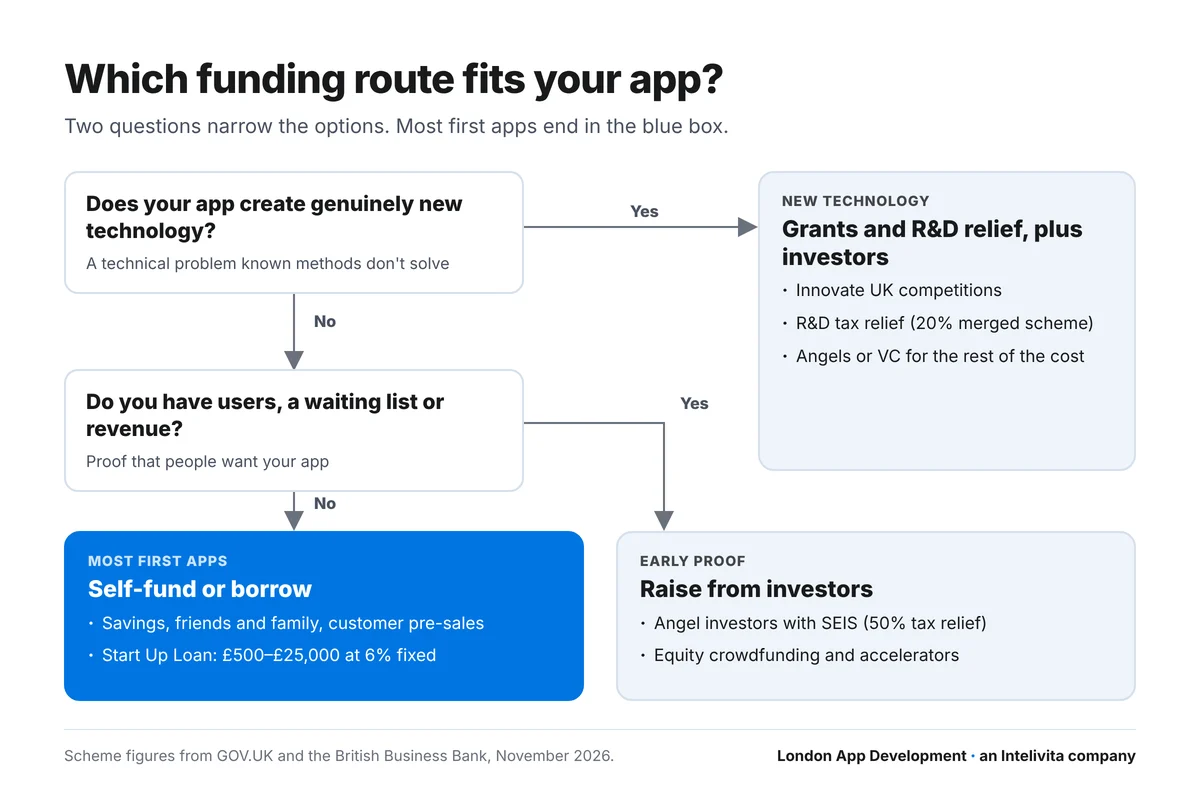
Text version: new technology → grants and R&D tax relief, plus investors · no new technology and no proof → savings, pre-sales, friends and family or a Start Up Loan · no new technology but early proof → SEIS angels, equity crowdfunding or accelerators.
Most booking, ecommerce, delivery and membership apps use proven technology. They start in the self-fund or borrow group, then move to angels once users arrive.
What are the UK funding options for app development?
There are 9 main sources of app development funding in the UK. Five keep you in full control, and four cost you shares or come with strict rules.
| Funding route | Amount | Cost to you | Proof needed | Time to money |
|---|---|---|---|---|
| Savings | What you have | Your own risk | None | Immediate |
| Customer pre-sales and pilots | What customers pay | Nothing | A product people buy | Weeks |
| Friends and family | Agreed with them | A loan or shares | Trust | Weeks |
| Start Up Loan | £500–£25,000 per person | 6% fixed interest | Business plan and cashflow forecast | Weeks |
| Accelerators and competitions | Small cash prizes or stakes | Shares, or nothing for prizes | A team and early traction | Fixed intake dates |
| Angel investors (SEIS/EIS) | From £10,000 per angel | Shares | Prototype or early users | Months |
| Equity crowdfunding | Set by your campaign | Shares and platform fees | A community of fans | Months |
| Venture capital | Large rounds | Shares and board influence | Fast growth, big market | Months |
| Grants and R&D tax relief | Set by each competition or claim | Strict rules | Genuinely new technology | Long and competitive |
Savings and bootstrapping
Bootstrapping means you fund the app with your own money and keep 100% of your company. Your limit is the money you’re willing to lose.
Track your burn rate, the cash you spend each month. Divide your cash by your burn rate to get your runway in months. To stretch it, build an MVP first with only the features users need on day one. Many founders keep a job or consult part-time while they build.
Customers as your first funders
Customers are the cheapest funders, because their money costs you no shares and no interest. A business that already sells funds its app from cashflow.
- Business apps: sell a paid pilot to your first client before the build.
- Consumer apps: take pre-orders or offer founding-member pricing.
- Existing businesses: fund the first version from current revenue.
Friends and family
Money from friends and family is fast but personal. Write the deal down, even for small amounts. State whether it’s a loan with repayment dates or shares in your company.
Start Up Loans
A Start Up Loan is a government-backed personal loan from the British Business Bank. You borrow £500 to £25,000 at 6% fixed and repay it over 1 to 5 years. Each partner applies separately, up to £100,000 per business. You also get 12 months of free mentoring.
Here’s the real cost. A £25,000 loan over 5 years costs £483 a month and £28,999 in total. That covers a simple app build with room for support. You repay it personally, even if the app fails.
A Start Up Loan is a safer choice than a credit card, which forum replies suggest for speed. The rate is fixed, and the mentoring is included (British Business Bank).
Angel investors
Angel investors are individuals who invest their own money in early companies for shares. UK angels invest from £10,000, and angel groups pool money into larger rounds. SeedLegals reports that 8 in 10 UK angel investments use SEIS or EIS tax incentives.
How do SEIS and EIS tax incentives work?
SEIS and EIS give investors income tax relief on new shares in your company. SEIS gives 50% relief and EIS gives 30%. That cuts the investor’s risk, so early app startups become easier to back.
| SEIS | EIS | |
|---|---|---|
| Best for | Your first raise | Larger rounds after SEIS |
| Most your company raises | £250,000 in total | £10m a year, £24m lifetime (from 6 April 2026) |
| Company conditions | Trade under 3 years old, under 25 staff, assets up to £350,000 | Assets up to £30m before and £35m after the share issue |
| Investor’s income tax relief | 50% | 30% |
| Investor’s yearly limit | £200,000 | £1m (£2m with knowledge-intensive companies) |
| Minimum holding | 3 years | 3 years |
Here’s the investor’s maths. An angel puts £20,000 into your SEIS round and claims £10,000 back from income tax. Their money at risk drops to £10,000.
Apply to HMRC for advance assurance before you pitch. HMRC confirms your company looks likely to qualify, and UK angels expect it. Sources: GOV.UK SEIS, GOV.UK EIS limits, checked November 2026.
Accelerators, incubators and competitions
Accelerators give a small investment, mentoring and investor introductions in exchange for shares. They run fixed intakes, so check dates early. Pre-seed accelerators accept founders before an MVP exists.
- University incubators: many UK universities run one for students and graduates.
- Regional programmes: local accelerators and Growth Hubs, some with public support.
- Startup competitions: cash prizes with no shares given away.
Crowdfunding
Crowdfunding raises small amounts from many people online. There are 2 types:
- Equity crowdfunding: the public buys shares through an FCA-authorised equity crowdfunding platform such as Crowdcube. It works best when customers already love your product.
- Reward crowdfunding: backers pay for an early version or a perk on Kickstarter or Indiegogo. It suits apps linked to a physical product or a fan community.
Building an app that itself raises or moves money is a different project. That falls under fintech app development, with FCA rules to plan for.
Venture capital
Venture capital firms invest large sums in companies that grow fast. They want a large market, a strong team and rapid user growth. App founders raise from angels first, then meet VCs at Series A.
Can you get a grant for app development in the UK?
Grants for app development in the UK fund innovation, not ordinary apps. Innovate UK’s open Smart Grants, the main any-sector grant, have been paused since January 2025.
The founder in the r/business thread applied for grants for a fitness app and was rejected every time. Grants exist for new technology, new methods and specific themes.
Innovate UK now funds businesses through themed competitions and the Growth Catalyst programme. Each competition sets its own theme, eligibility and closing date. Check these sources for funding opportunities open today:
- Find a grant on GOV.UK, the search for all public grants.
- Innovation Funding Service, where Innovate UK lists competitions.
- IUK Business Connect, which explains open opportunities.
- Your local Growth Hub, Scottish Enterprise, Business Wales or Invest NI.
EU funding: the UK is an associated country in Horizon Europe. UK businesses apply to its programmes, and a single startup applies to the EIC Accelerator (IUK Business Connect). Both target deep technology, not standard apps.
How do you write a grant application for an app?
A grant application for an app proves 4 things: a real problem, a new technical solution, a clear plan and a sensible budget.
- The problem. Who suffers from it, how many people, and what it costs them.
- The innovation. What’s technically new, and why existing tools don’t solve it.
- The plan. Milestones, the team and the risks, with how you’ll manage each.
- The budget. Costs line by line, plus your match funding where the competition asks for it.
Read the competition’s scope twice before you write a word. An application outside the scope fails, however good the idea.
Does R&D tax relief cover app development?
R&D tax relief covers app development only when the work seeks an advance in science or technology. HMRC guidance CIRD81960 says configuring existing software, routine changes and screen testing don’t qualify.
Here’s how the HMRC test applies to 3 apps:
| App | Qualifies for R&D relief? | Why |
|---|---|---|
| Booking app for a salon chain | No | Known methods solve every technical problem |
| App using a new machine learning method | Yes, for the R&D work | The outcome is technically uncertain |
| App linking 6 legacy systems in real time | Only the uncertain parts | Routine integration doesn’t count |
For periods from 1 April 2024, the merged scheme gives a 20% expenditure credit. Loss-making small companies spending 30% or more on R&D use ERIS. ERIS adds an 86% deduction and a payable credit of up to 14.5% (GOV.UK). Check your claim with an R&D tax adviser.
What do investors check before funding an app?
Investors check 7 things before funding an app: the problem, who pays, the team, the market, what makes you different, traction and their return.
| What investors check | What they want to see |
|---|---|
| A real problem | Data or user interviews proving the pain |
| Who pays | A clear business model: subscription, commission or one-off |
| A team that builds | Technical skills in the team, or a fixed build plan |
| A big enough market | UK and global user numbers, with sources |
| Why you’re different | How you beat the tools users have today |
| Traction | Active users, retention and revenue over time |
| Their return | How the company grows enough to repay their risk |
Is 100,000 registered users enough to raise funding?
100,000 registered users isn’t enough on its own to raise funding. Investors discount sign-ups and ask how many people use the app every month.
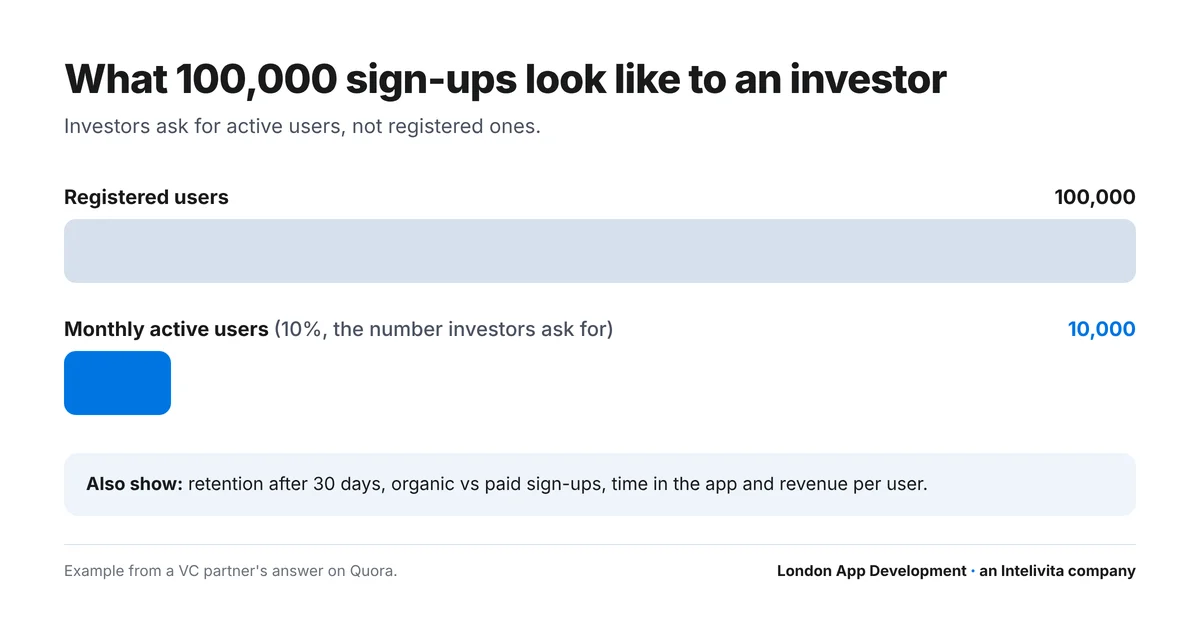
A VC partner on Quora put it simply. 100,000 sign-ups with 100,000 monthly active users is amazing. 100,000 sign-ups with 10,000 active users shows you don’t keep people. Show investors these numbers instead:
| Metric | What it shows |
|---|---|
| Monthly and daily active users (MAU, DAU) | How many people use the app |
| Retention after 30 days | Whether users come back |
| Organic vs paid sign-ups | Whether users find you without ads |
| Time in the app | How much users value it |
| Revenue per user | Whether the business model works |
A product manager in the same thread called 70% of users still active after 30 days a good result.
Where can you find app investors in the UK?
App investors in the UK are found through warm introductions, angel networks, events and accelerators. Warm introductions are the fastest way to find investors for your app idea, because investors trust people they already know.
- Warm introductions. Ask your accountant, lawyer, mentors and other founders who they know.
- Angel networks. Angels Den (London, £50,000–£1m), UK Angel Investment Network (£10,000–£10m) and Minerva (West Midlands, £25,000–£500,000). SeedLegals lists 21 UK angel groups that back mobile apps.
- Events and meetups. Startup events, hackathons and demo days put you in front of investors.
- Accelerators. Programmes introduce you to investors at a demo day.
- Cold outreach with data. LinkedIn messages work when they lead with traction, not the idea.
Pitch angels before venture capital firms at the early stage. Check each investor’s sectors, cheque size and SEIS use before you reach out.
Watch out for fake investors. Unsolicited offers in comments and direct messages ask for your deck or an upfront fee. A real investor never charges you to invest.
How do you pitch your app idea to investors?
To pitch your app idea to investors, show the problem, who pays, your proof, your build plan and how much you need. Fit it into 10 to 12 slides and a 10-minute talk.
- Problem: who suffers and how much it costs them.
- Solution: what your app does, shown as a demo or prototype.
- Market: UK market size in users, with a source.
- Business model: who pays, how much and how frequently.
- Traction: active users, retention, pre-orders or pilots.
- Competition: what users do today and why they’ll switch.
- Team: why your team solves this problem.
- Build plan: a fixed quote, timeline and milestones.
- The raise: the amount, what it buys and the runway it gives, backed by a 12-month financial forecast.
- Ask: SEIS eligibility and the next step.
Practise an elevator pitch too: 30 seconds, with one sentence each on the problem, the app and your proof. When an investor wants to go ahead, they send a term sheet with the amount, valuation and investor rights. Have a startup lawyer review it before you sign.
Will someone steal your app idea?
An app idea is rarely stolen, because execution is the hard part. If someone copies your idea overnight, it had no lasting advantage to protect.
Protect the work you share with 2 documents:
- A non-disclosure agreement (NDA) before you share detailed plans with a developer or partner.
- A build contract that assigns the IP to your company. You own the code, designs and data once you’ve paid.
When you pitch an app idea to investors for the first time, share the problem and your proof, not your technical secrets. Comparing a UK team with an offshore one changes how you share your brief. The trade-offs of outsourcing your app development cover contracts, time zones and communication.
Can you sell your app idea instead?
You rarely sell an app idea on its own, because buyers pay for proof, not plans. A working app with active users and revenue sells. To profit from your idea, build the smallest version that proves demand first.
You’ve got funding: how do you spend it safely on your build?
Spend app funding safely by fixing the scope and price, paying by milestone, and keeping 6 to 12 months of runway. Your company also owns the code from day one.
The r/reactjs founder who “just got funding” weighed learning to code in 3 months. Replies called that unrealistic for a web app plus iPhone and Android apps. Use these 6 rules instead:
- Start with one codebase. A cross-platform build covers iPhone and Android, or launch one platform first.
- Fix the scope before the price. A written feature list stops costs creeping up.
- Pay by milestone. Release money as each working part is delivered.
- Start small. A first milestone tests your developer before the full budget.
- Own the code and IP. Your company holds the source code, designs and accounts.
- Keep runway. Hold back 6 to 12 months of support and marketing money.
Funding isn’t the finish line. Building an app is a continuous cycle: release a small part, learn from real users, then build the next part. Keep money back for that second round of changes.
Your launch needs money too. The App Store and Google Play steps sit in our guide on how to launch an app.
What are the funding stages for an app startup?
Startup funding comes in stages: pre-seed and seed funding pay for the first version of an app. Series A and later rounds pay for growth once demand is proven.
| Stage | What you have | What the money pays for | Main sources |
|---|---|---|---|
| Pre-seed | Idea, research, a prototype | Validation, prototype, first MVP | Savings, friends and family, Start Up Loan, SEIS angels |
| Seed | An MVP and early users | Launch, product fixes, first marketing | SEIS and EIS angels, crowdfunding, accelerators |
| Series A | Clear demand and growing revenue | A bigger team, more platforms | Venture capital, EIS |
| Series B and later | A proven business model | New markets and products | Venture capital, growth funds |
First-time app founders sit at pre-seed or seed. Series A and later belong in your plan, not your first pitch.
Frequently asked questions
How can I get funding for my app idea with no money?
Start with proof, not a pitch. Talk to 20 to 50 target users, build a clickable prototype, and collect a waiting list. Then approach friends and family, apply for a Start Up Loan, or find a technical co-founder who works for shares.
Can I get funding for an app without giving up equity?
Yes. Savings, customer pre-sales, a Start Up Loan, startup competition prizes and grants leave you with 100% of your company. Loans need repaying, and grants need genuinely new technology.
How long does it take to raise money for an app?
A Start Up Loan takes weeks. An angel round takes months, from first meetings to money in the bank. Grants and venture capital take the longest, so start raising before your savings run low.
Do I need an MVP before I look for investors?
No, but you need proof. A clickable prototype with user feedback works for early angels and pre-seed accelerators. Larger investments follow a working MVP with active users.
Can I get a Start Up Loan to build an app?
Yes, when the app is part of a new business plan the lender approves. You borrow £500 to £25,000 at 6% fixed over 1 to 5 years. Twelve months of free mentoring comes with it.
Are there free government grants for app development?
Not for most apps. UK grants fund innovation, and Innovate UK’s open Smart Grants have been paused since January 2025. Check Find a grant on GOV.UK for themed competitions that match your technology.
Is 100,000 registered users enough to get VC funding?
No, not on its own. Investors ask how many users are active each month, how many return after 30 days, and how many pay. 100,000 sign-ups with 10,000 monthly active users signals a retention problem.
What is SEIS and how does it help app startups?
SEIS is a UK tax scheme that gives investors 50% income tax relief on shares in new companies. Your company raises up to £250,000 under SEIS. It must be under 3 years old, with fewer than 25 staff.
How much equity do angel investors take in an app startup?
The share an angel takes equals their investment divided by your company’s value after the round. A £50,000 investment at a £500,000 post-money valuation buys 10%. Each new round causes dilution, so raise only what you need to reach your next milestone.
Should I build my app before looking for funding?
Build the cheapest version that proves demand, not the full app. A clickable prototype or a no-code test shows investors that users want it. Spending your whole budget before validation leaves nothing for changes.
Get a fixed price you can take to investors
Investors trust a number backed by a scope and a timeline. LAD gives you both after a free call. We scope your app, fix the price and split the build into milestone payments that match your funding.
As an app development company in London, our team turns your feature list into a quote ready for your pitch deck. Bring your idea and your budget, and we’ll show you what a first version includes.
Sources and method: scheme figures from GOV.UK SEIS guidance, the GOV.UK EIS limit increase, the British Business Bank, HMRC CIRD81960, GOV.UK R&D relief, UKRI and SeedLegals, checked November 2026. Build prices from LAD’s fixed-price bands. Loan repayments calculated at 6% fixed over 60 months. Founder questions from 11 Reddit and Quora threads reviewed November 2026.